If you have ever stood in a fitting room holding two one-piece garments and wondered which one will actually earn its place in your closet, you are in exactly the right place. The plus size overalls vs jumpsuits question comes up constantly in our community, and it deserves a real answer instead of a vague "it depends." Both are one-and-done outfits that remove the daily work of matching a top to a bottom, but they solve different problems, suit different lifestyles, and ask different things of your wardrobe. This guide walks through construction, rise and torso fit, layering, bathroom practicality, styling range, fabric and care, and finishes with a clear decision guide so you can choose the silhouette that genuinely fits your days.
A one-piece garment is one of the most efficient things a plus-size woman can own. One hanger, one decision, a complete look. Yet overalls and jumpsuits are not interchangeable, and treating them as such is why so many people end up with a piece that hangs unworn. The good news is that once you understand how each one is built and how each one behaves on a curvy frame, the choice becomes surprisingly simple.
The Real Difference Between Overalls and Jumpsuits
At a glance the two look like cousins, but the engineering underneath is completely different, and that engineering is what you feel all day long. One suspends itself from your shoulders and lets the waist stay relaxed; the other sculpts a single continuous column from neckline to hem. That single structural difference cascades into how each one fits, how it layers, how easy it is to live in, and how dressy it looks. Once you can picture the construction, you can predict almost everything else about the garment before you ever try it on.
Overalls: A Bib, Straps and Often Adjustable Hardware
Overalls begin with a bib, the rectangular panel that sits across your chest, held up by two straps that usually fasten with buckles or clasps. Below the bib, the garment opens into a trouser, a short, or a skirt with a dress-like silhouette. That visible strap-and-bib architecture is the defining feature, and it is also what makes overalls so forgiving. Because the fit is anchored at the shoulders and adjusted with the straps, the waist can stay relaxed without the piece sliding down. If your torso length has ever made a standard dress sit wrong, that adjustability is quietly powerful.
Jumpsuits: One Continuous Silhouette
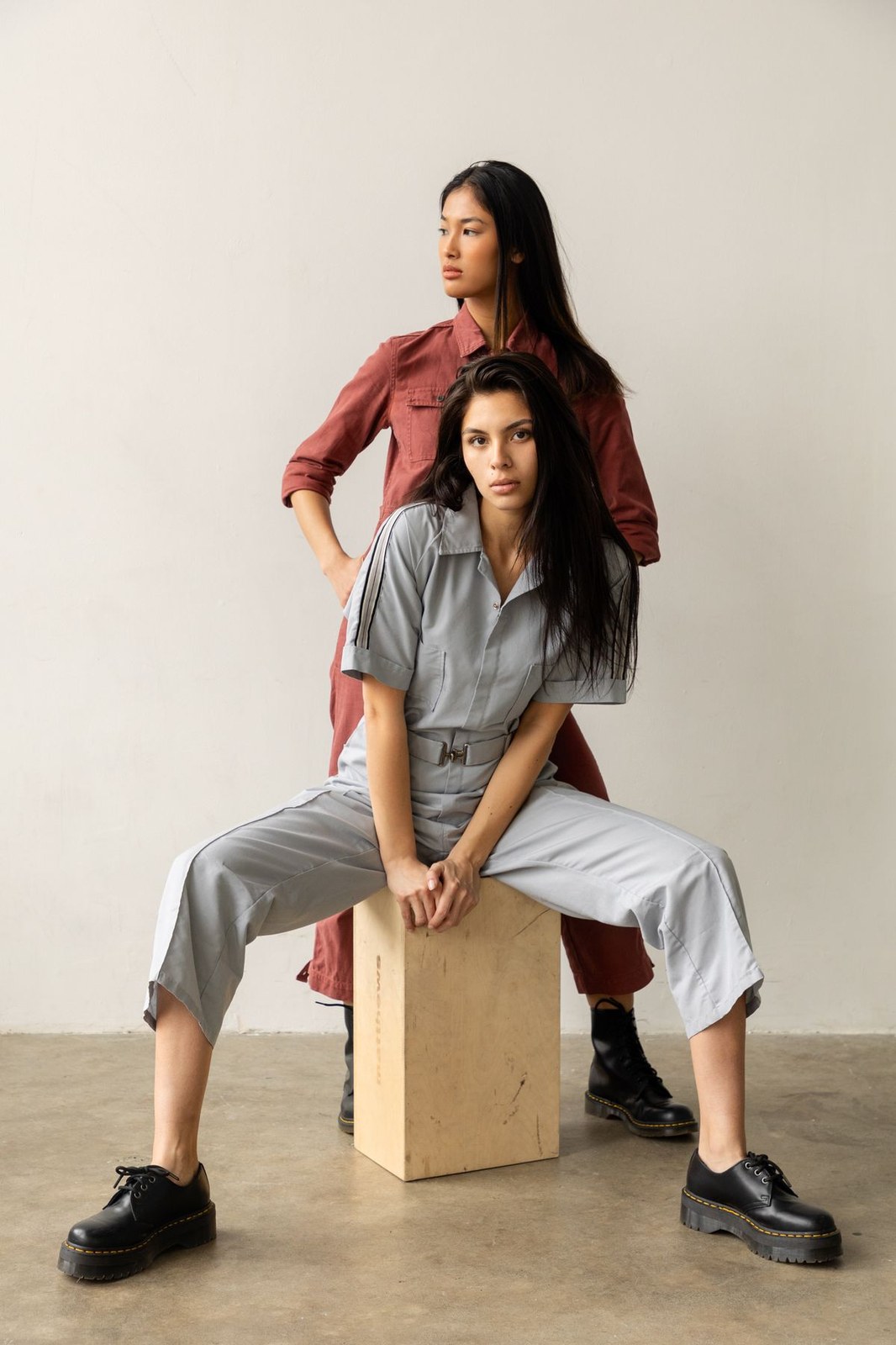
A jumpsuit is a single, unbroken garment from shoulder to hem, usually with no bib and no straps. Instead it relies on a neckline, a waist seam or tie, a zip, and sometimes a wrap or button placket to create shape. The result is sleeker and more streamlined by nature. There is no hardware interrupting the line, which is why jumpsuits read as more dressed-up and more polished than overalls in the same fabric. The trade-off is that a jumpsuit has to fit your torso almost perfectly, because there are far fewer points of adjustment.
Why the Distinction Matters More in Plus Sizes
On a straighter frame, a jumpsuit that is slightly long in the torso simply hangs a little lower. On a curvy frame with a fuller bust, a longer rise, or a soft tummy, that same extra length can pull, ride, or create tension across the front. Overalls absorb some of that variation through their straps; jumpsuits do not. This does not make jumpsuits a worse choice, it makes them a choice that rewards careful measuring. Understanding which side of the plus size overalls vs jumpsuits debate you are shopping on is the first real step toward a one-piece you reach for weekly.
Rise, Torso Length and Fit: The Details That Decide Everything
Fit is not a size on a label, it is a set of measurements working together. For one-piece garments there are three that matter most.
Torso Length Is the Make-or-Break Measurement
Your torso length is the distance from the top of your shoulder to your natural waist. It is the single number that predicts whether a one-piece will feel comfortable or constantly tug. A longer torso needs a longer rise and a deeper bib; a shorter torso needs the opposite. When shopping, look for pieces described as having a "long torso" or "regular torso" fit, and check the model height notes. If a jumpsuit feels like it is pulling at the shoulder while the crotch sits low, the torso is too short for you, not your body is wrong for the garment. Sizing up often fixes the rise but can leave the shoulders falling off, which is exactly where adjustable overall straps win.
Rise and Where the Waistband Sits
Rise describes where the waist seam falls relative to your natural waist. A high rise sits at or just above the belly button and creates a defined, leg-lengthening line. A mid rise sits near the hip bones. For overalls, the practical question is whether the side buttons or the waist seam sits at a spot you find comfortable when seated. For jumpsuits, the waist seam is usually fixed, so try it on seated as well as standing. Anything that digs when you sit will dig all day.
Straps, Buckles and Adjustability
Overalls live or die by their straps. Look for wide straps that distribute weight across the shoulder rather than thin ones that cut in, and for buckles or clasps that are easy to open and close without a mirror. Elasticated back panels are a small detail with a big payoff, because they let the bib move with you as you bend and reach. If you carry weight in your bust, a wider strap with a slightly forward attachment point will feel far more secure than a narrow strap set at the very edge of the shoulder.
How to Read a Size Chart Like a Stylist
Ignore the letter on the tag and read the numbers. Measure your bust, your natural waist, your fullest hip, and your torso length. Compare your bust to the chart first for the top half, then your hip for the bottom half. When the two land in different sizes, and on curvy bodies they often do, let the larger measurement guide you and plan on a belt or a tailored seam if needed. For a deeper walkthrough, our fit guidance pairs well with browsing the full range in plus size overalls, where strap and rise details are easy to compare side by side.
Layering: What You Can Wear Under Each One
Layering is where the two silhouettes diverge the most, and it is the fastest way to double the number of outfits each piece can produce.
Under Overalls: Tees, Turtlenecks and Sweaters
Overalls are the more generous host. Because the bib and straps create an opening, you can wear a fitted tee, a ribbed turtleneck, a slim long-sleeve knit, or even a lightweight sweater underneath, and the straps simply frame it. In cooler months a turtleneck under a corduroy or denim bib is one of the most comfortable cold-weather combinations around. Just keep the base layer smooth and not too bulky at the neckline, so it sits flat under the bib instead of bunching.
Under Jumpsuits: Smooth, Seamless Layers
A jumpsuit usually closes at the front, so whatever you wear underneath needs to stay invisible and flat. That means seamless or lightly lined undergarments, smooth camisoles, and base layers that do not create ridges under a fitted bodice. In fall and winter you can absolutely wear a fine-gauge turtleneck or a long-sleeve layering top beneath a jumpsuit with a deep neckline or an open placket, but a chunky sweater underneath is rarely comfortable. Think thin and smooth for jumpsuits, cozy and slightly larger for overalls.
Seasonal Layering and Outerwear
Both pieces layer beautifully under a cardigan, a denim jacket, a long coat, or an oversized blazer. Overalls tend to look best with shorter, boxier outerwear that shows the straps. Jumpsuits tend to look best with a longer, cleaner coat that echoes their streamlined line. In every case, check that the outer layer can close comfortably over the one-piece without straining at the bust or the shoulder.
Bathroom Practicality and Real-Life Ease
Let us talk about the thing everyone wonders about and few guides mention. Practicality matters, and pretending otherwise helps no one. A garment can be beautiful and still be a poor fit for a busy day, so it is worth thinking honestly about how a one-piece behaves in real life before you fall in love with it on a hanger.
Both overalls and jumpsuits have been worn by people with every kind of body for generations, and both have small design details that make daily life easier or harder. The trick is to spot those details while you shop, not after you have already brought the piece home.
Overalls: Straps and Clasps
Overalls generally ask you to unclip or unbutton the straps and let the bib fall forward, which most people can manage quickly once they have done it a few times. The learning curve is short, and the movement becomes automatic. Wide, easy-to-grip clasps make a real difference here, as does a bit of stretch in the fabric so the garment moves with you instead of fighting you.
Jumpsuits: Zips, Wraps and Stretch
Jumpsuits vary widely. A wrap-front or a deep front zip can be quick and simple. A back zip can be fiddly. The easiest jumpsuits to live in are those with some stretch and an accessible closure. When you try one on, do a full practice run before you commit, standing up, sitting down, and reaching. If it is awkward in the fitting room, it will be awkward in a restaurant bathroom.
Tiny Habits That Make Either Easier
Choose stretch fabrics over stiff ones, prefer front closures over back ones when you can, and look for pieces with a bit of elastic at the waist. Keep a light cardigan or jacket nearby, since it doubles as a quick cover. These are small decisions, but they are the difference between a one-piece you wear once and a one-piece you wear weekly.
Styling Flexibility: Day, Work, Weekend and Evening
Casual and Everyday
Overalls are the natural choice for errands, school runs, garden days and weekends. Pair denim or corduroy overalls with a striped tee and sneakers, or layer a soft knit under a bib for a cozy autumn look. They are relaxed by nature, which means they look intentional even when you have done almost nothing.
Work and Smart-Casual
Jumpsuits shine in smart-casual settings. A well-cut jumpsuit in a fluid fabric reads polished with loafers and a structured bag. If your workplace is creative or business-casual, a solid-tone jumpsuit is a genuinely easy way to look put together. Overalls can work in a relaxed office too when the fabric is tailored, the colour is deep and solid, and you add a crisp shirt underneath.
Evening and Events
For dinners and celebrations, a jumpsuit in velvet, satin or a crepe with a defined waist is a strong alternative to a dress, especially if you love the freedom of trousers. Overalls rarely read as evening wear, though a dark, tailored pair with heels and statement jewellery can absolutely hold its own at a casual gathering. If you want one piece that spans the most occasions, the jumpsuit is usually the more versatile evening option.
Fabric, Season and Care
Denim, Corduroy, Twill and Linen
Denim is the classic overall fabric, sturdy and endlessly casual. Corduroy adds warmth and a lovely ridged texture, which is why it dominates fall and winter overalls. Cotton twill and stretch blends feel smoother and dressier, and they drape well in jumpsuits. Linen and lightweight blends are ideal for warm weather, particularly in wide-leg shapes that keep air moving. Match the fabric to the season first, and the silhouette second.
Stretch and Recovery
A touch of spandex or elastane, roughly two to four percent, transforms how a one-piece feels. It lets the garment move when you sit, bend and reach, and it helps the fabric spring back instead of bagging at the knees or the seat. Too much stretch in a heavy fabric can make it feel flimsy, so aim for a blend that keeps its structure. Recovery, the ability to return to shape, is the real test of quality.
Washing and Care Tips
Wash denim and corduroy inside out in cold water on a gentle cycle, and skip the dryer to protect the fit and the finish. Corduroy in particular should be hung to dry and brushed back into line so the ridges stay crisp. Turn hardware away from other garments so buckles do not snag. Tumble drying is the fastest way to shrink a one-piece out of its comfort zone, so treat air drying as your default.
A Side-by-Side Comparison and Lifestyle Decision Guide
Here is the honest plus size overalls vs jumpsuits comparison, condensed so you can see the trade-offs at a glance.
| Feature | Overalls | Jumpsuits |
|---|---|---|
| Top structure | Bib and adjustable straps | Strapless neckline, no bib |
| Fit tolerance | High, straps adapt to torso length | Lower, torso must fit closely |
| Layering under | Generous, tees and knits fit easily | Needs smooth, thin base layers |
| Bathroom ease | Unclip straps | Depends on closure and stretch |
| Style range | Casual and weekend | Polished, work and evening |
| Best fabrics | Denim, corduroy, twill | Crepe, satin, fluid blends |
Choose Overalls If...
You want everyday ease, you love to layer, your torso length is hard to fit, or you prefer a relaxed, hands-on lifestyle. Overalls are the more forgiving, more casual, more adjustable choice, and they are wonderful for anyone who values comfort and the freedom to move.
Choose Jumpsuits If...
You want a streamlined, dressier look from one hanger, you have a torso that matches standard sizing reasonably well, and you want something that works for dinner, an event or a smart office. Jumpsuits are the more polished, more streamlined, more elegant choice. You can explore the full range of sleek one-pieces in jumpsuits to see how a clean, continuous line changes the feel of an outfit.
Can You Own Both?
Absolutely, and many people should. A sturdy pair of overalls for weekends and a fluid jumpsuit for evenings is a genuinely complete one-piece wardrobe. They serve different moods rather than competing for the same moment, so owning both is not overkill, it is good planning.

FAQ: Plus Size Overalls vs Jumpsuits
Which is more comfortable for a plus-size body, overalls or a jumpsuit?
Comfort depends less on the category and more on the fit. Overalls are generally more forgiving because the straps adapt to your torso, which helps if standard sizing rarely fits your proportions. Jumpsuits can be just as comfortable when the torso length and rise are right and the fabric has some stretch. Try both seated, not just standing, and trust how they feel when you move. In the end, the plus size overalls vs jumpsuits decision should follow your body, not a trend.
Are jumpsuits harder to get in and out of than overalls?
It varies by design. Overalls usually need you to unclip or unbutton the straps, which people learn quickly. Jumpsuits range from very easy wrap or front-zip styles to fiddlier back-zip styles. When you shop, prioritise accessible closures and a bit of stretch, and always do a practice run before you decide.
Which one-piece should I choose for fall and winter?
Corduroy or heavier denim overalls are hard to beat for cold weather because they layer generously over turtlenecks and knits and look wonderful with boots. If you prefer a sleeker cold-weather look, choose a jumpsuit in a heavier crepe or a lined fabric and add an oversized coat on top. Both work; overalls lean cozier and jumpsuits lean cleaner.
Do I need to size up in overalls or jumpsuits?
Only if a specific measurement calls for it. Use your bust, waist, hip and torso length rather than the label, and let the largest measurement guide your size. In overalls, you can often stay true to size and use the straps to fine-tune. In jumpsuits, if the torso runs short, sizing up can help the rise while keeping the waist comfortable.