Chaussettes invisibles grandes tailles : le guide d'ajustement pour pieds larges qui ne glisse pas
Aug 20, 2026

Pourquoi les socquettes invisibles grande taille constituent une catégorie à part entière
La plupart des articles de bonneterie sont jugés par la surface de jambe qu'ils couvrent et leur confort. Les socquettes invisibles grande taille relèvent ce défi d'une toute autre manière. Leur objectif principal est de disparaître au-dessus de la ligne de la chaussure tout en refusant obstinément de glisser du talon. Si elles sont mal conçues, vous passerez la journée avec un amas de tissu froissé sous la voûte plantaire, ou pire, une chaussette migrant silencieusement dans votre chaussure à chaque pas. C'est précisément pourquoi les socquettes invisibles méritent leur propre guide, au lieu d'être regroupées avec les modèles courtes ou montantes.
La promesse d'une socquette invisible est simple : porter des baskets, des mocassins ou des ballerines et avoir l'air pieds nus, tout en gardant une couche de tissu doux et respirant entre votre peau et la chaussure. Pour les femmes grandes tailles aux pieds plus larges, cette promesse est plus difficile à tenir. Un revers qui doit s'étirer sur un cou-de-pied plus volumineux est moins profond et adhère moins, et le même pied large qui rend le shopping difficile fait aussi glisser les socquettes invisibles. Ce guide explore les mécanismes d'ajustement réels afin que vous puissiez choisir des paires qui restent réellement en place.
Le paradoxe invisible-mais-ancré
Une socquette invisible vit dans la tension entre deux exigences opposées. Elle doit être suffisamment courte pour disparaître, mais suffisamment sûre pour s'ancrer. Plus le revers visible est court, moins il y a de tissu pour agripper le talon, ce qui est précisément la raison pour laquelle les socquettes invisibles bon marché échouent d'abord à l'arrière du pied. La solution d'ingénierie n'est pas simplement de la rendre plus longue, car cela va à l'encontre de l'objectif, mais de placer l'adhérence et la structure exactement là où elles comptent. Tout ce qui suit revient à ce paradoxe.

Le problème du glissement du talon et ses causes réelles
Le glissement du talon est la plainte numéro un concernant les socquettes invisibles, et il est rarement aléatoire. C'est le résultat prévisible de quelques décalages mesurables entre votre pied, la chaussette et la chaussure. Comprendre chaque cause vous permet de corriger le bon problème au lieu d'acheter une autre paire décevante. Avant de blâmer la marque, vérifiez l'ajustement : la plupart des glissements proviennent d'un étirement du revers, de la longueur du pied ou d'une chaussure qui ne coopère tout simplement pas avec un revers bas.
Circonférence du revers versus circonférence du pied
Le revers est l'anneau élastique en haut de la chaussette. Sa circonférence détendue doit être inférieure à la circonférence de votre talon et de votre cou-de-pied pour qu'il puisse serrer, mais il doit également s'étirer confortablement sur la partie la plus large de votre pied lorsque vous l'enfilez. Lorsqu'une chaussette est conçue pour un pied plus étroit, le revers s'étire excessivement, perd son adhérence et descend. Pour les pieds larges, une chaussette étiquetée taille unique est le suspect habituel.
L'absence de languette au talon
De nombreuses socquettes invisibles ne comportent pas la petite languette rembourrée qui se trouve derrière le tendon d'Achille. Cette languette a deux fonctions : elle protège la peau délicate à cet endroit et elle offre au revers un point d'ancrage. Sans elle, l'arrière du revers se place plus bas et l'ouverture du talon bâille chaque fois que votre pied fléchit. Une petite caractéristique, une grande différence en termes de tenue.
Les antidérapants en silicone : placement et dégradation
Les points de silicone transparents le long du bord intérieur du revers sont la solution moderne contre le glissement. Le placement est plus important que la quantité. Les points doivent être placés à l'intérieur du revers, là où il touche la peau, et non à l'extérieur où ils ne servent à rien. Au fil des mois, les huiles corporelles, la chaleur et les lavages agressifs dégradent le silicone jusqu'à ce qu'il ressemble à du tissu ordinaire. Lorsque les antidérapants ne sont plus adhérents, la chaussette est effectivement mise au rebut même si le tricot semble en bon état.
Longueur du pied de la chaussette trop longue
Une socquette invisible trop longue au niveau du pied agit comme un hamac. L'excès de tissu s'accumule sous la voûte plantaire et tire le revers vers l'avant et vers le bas à chaque pas. Comme les tailles pour pieds larges ne font parfois qu'augmenter la longueur avec la largeur, vous pouvez vous retrouver avec une semelle intérieure trop longue d'une taille. Adaptez la longueur du pied à votre pointure réelle, et pas seulement à la largeur.
Mauvais assortiment de chaussures
Certaines chaussures ne sont pas compatibles avec les socquettes invisibles. Des cols très bas ou lâches ne donnent au revers rien derrière quoi se cacher, de sorte que tout glissement est instantanément visible et la chaussette a moins de soutien. Les baskets rigides à talon haut ont tendance à coopérer ; les chaussures à enfiler souples non. L'association compte autant que la chaussette elle-même.
Pourquoi des pieds plus larges font glisser davantage les socquettes invisibles
Voici la question centrale pour notre public. Pour enfiler un pied large dans une socquette invisible, le revers doit s'étirer sur un cou-de-pied plus grand. Plus il s'étire, plus il doit remonter haut sur le talon pour dégager ce cou-de-pied, ce qui signifie qu'il se positionne moins profondément par rapport à l'os du talon et adhère à une zone de peau plus petite, plus ronde et plus glissante. Moins d'adhérence plus plus d'étirement équivaut à plus de glissement. C'est pourquoi les socquettes invisibles grande taille génériques échouent d'abord sur les pieds plus larges, et pourquoi une construction spécifique aux pieds larges n'est pas un argument marketing.
Géométrie de l'invisibilité : adapter la profondeur du revers au col de la chaussure
Rester en place n'est que la moitié de la bataille. Une socquette invisible doit aussi rester cachée, et la hauteur cachée n'est pas la même pour toutes les chaussures. La géométrie est simple une fois que vous la mesurez.
Ce que mesure réellement la profondeur du revers
La profondeur du revers est la distance entre le haut de l'os du talon et le bord supérieur du revers de la chaussette, mesurée le long de l'arrière du pied. Ce n'est pas la même chose que la hauteur de la chaussette vue de côté. Un revers plus profond monte plus haut derrière le talon ; un revers moins profond s'arrête bas. L'astuce consiste à faire correspondre cette profondeur à la hauteur du col ou de l'empeigne de votre chaussure.
Hauteurs du col et de l'empeigne selon le type de chaussure
Les baskets ont un col rembourré qui se situe assez haut, donc une socquette invisible légèrement plus profonde se cache facilement. Les mocassins et les chaussures bateau ont une empeigne basse, ce qui exige un revers peu profond ou elle dépasse. Les ballerines et les mules exposent presque tout le dessus du pied, donc le revers doit être très bas et ajusté. Les chaussures de skate basses varient, alors vérifiez chaque paire que vous possédez.
La méthode mesure-et-adapte
Prenez une règle. Mettez la chaussure que vous comptez porter et marquez l'endroit où son col ou le haut de son empeigne se situe au-dessus de votre talon. Mesurez cette hauteur. Ensuite, mesurez la profondeur du revers d'une chaussette candidate de la même manière. Si la profondeur du revers de la chaussette est au niveau ou juste en dessous de la ligne de la chaussure, vous êtes invisible. Si elle est plus haute, vous verrez la chaussette ; si elle est beaucoup plus courte, elle pourrait ne pas s'ancrer. Faites cela une fois par style de chaussure et vous ne devinerez plus.
Invisible, Doublure, Socquette, Invisible : Décrypter le Chaos des Noms
Les marques désignent la même chaussette courte de douze façons différentes, ce qui rend la comparaison des achats pénible. Voici une carte pratique pour que vous puissiez faire vos achats en toute confiance entre les marques.
Socquette invisible versus doublure versus doublure de chaussure
Socquette invisible signifie généralement coupée suffisamment bas pour disparaître dans une basket. Doublure ou doublure de chaussure implique souvent une couche encore plus fine, parfois sans orteils, destinée uniquement à l'évacuation de l'humidité. Elles se chevauchent fortement ; la vraie différence est l'épaisseur et si le revers est conçu pour rester caché dans des chaussures ouvertes.
Socquette courte (footie) versus invisible
Le terme "footie" désigne souvent un style avec une petite bande autour de la cheville qui peut être légèrement visible, elle n'est donc pas vraiment invisible. "Invisible" est un raccourci marketing pour "no-show" (socquette invisible). Lisez la profondeur du revers, pas le nom sur l'emballage.
Coupe basse versus quart
La coupe basse se situe entre la socquette invisible et la socquette, laissant souvent apparaître un petit liseré au-dessus de la chaussure. La coupe quart monte jusqu'à environ un quart de la jambe, clairement visible. Ni l'une ni l'autre ne sont des socquettes invisibles, mais toutes deux sont classées comme des chaussettes courtes partout où vous regardez.
Comment naviguer dans ce chaos lors de l'achat
Ignorez l'étiquette. Recherchez la profondeur de revers mesurée, la fourchette de pointures indiquée et si des antidérapants sont décrits. Lorsqu'une annonce ne donne que S/M/L, c'est une supposition. Notre collection complète de chaussettes répertorie les spécifications afin que vous puissiez comparer les socquettes invisibles avec les options courtes et montantes côte à côte.
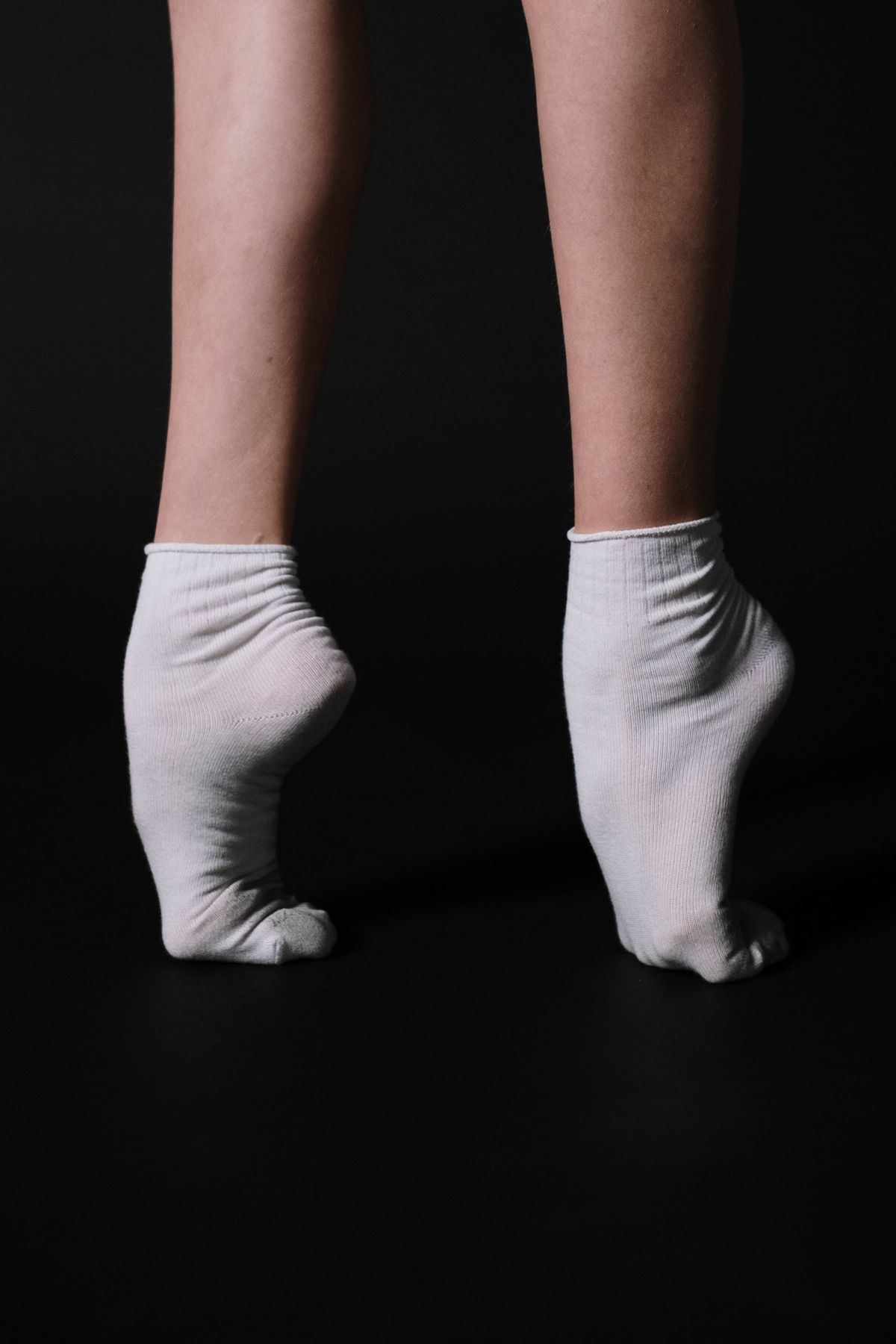
Anatomie de l'ajustement pour les pieds larges : pourquoi le dimensionnement numérique l'emporte
En ce qui concerne les socquettes invisibles grande taille, le système de taille sur l'étiquette est là où la plupart des problèmes d'ajustement commencent. Pour les pieds larges, la différence entre une bonne journée et une journée pleine d'ampoules réside souvent dans le système de taille de l'emballage plutôt que dans la couleur ou le prix.
Circonférence de l'avant-pied versus pointure
La pointure indique la longueur, pas la largeur. Deux femmes ayant la même pointure peuvent avoir une circonférence d'avant-pied très différente. Une socquette invisible taillée uniquement en fonction de la longueur de la chaussure peut être beaucoup trop serrée au niveau de la plante du pied, ce qui fait descendre le revers et rentrer les coutures.
Tailles de chaussettes numériques versus S/M/L
Les tailles numériques, par exemple les tailles de chaussettes 10-13 correspondant aux chaussures 8-12, vous indiquent la longueur réelle du pied et souvent la bande de largeur pour laquelle la chaussette a été tricotée. S/M/L masque cela. Pour les pieds larges, le numérique est presque toujours l'achat le plus sûr car vous pouvez faire correspondre le tour de pied, et pas seulement une vague estimation de petite à grande taille.
Coutures d'orteil et orteils sans couture
Une couture d'orteil épaisse appuyant sur une boîte à orteils large crée rapidement un point de friction. Les orteils sans couture ou tricotés à la main éliminent entièrement cette arête. Si une chaussette a une couture, vérifiez qu'elle traverse l'extrémité et qu'elle est plate ; une couture sur le côté de la boîte à orteils est un signal d'alarme.
Talons profonds
Une poche de talon adéquate est une coupe tricotée en forme de coupelle, et non un simple tube tourné à l'extrémité. Les poches profondes épousent l'os du talon afin que le revers se positionne là où il doit être au lieu de glisser. Les versions pour pieds larges approfondissent généralement cette poche, ce qui améliore précisément la performance de maintien.
Bandes de soutien de la voûte plantaire
Une bande de compression douce sur la voûte plantaire fait plus que soutenir ; elle ancre toute la chaussette de l'avant à l'arrière afin que le revers ne puisse pas bouger. Des bandes légères et non compressives sont les meilleures pour les grandes tailles afin qu'elles ne coupent pas ou ne laissent pas de marques.
Pourquoi une chaussette trop petite provoque la plupart des ampoules
Paradoxalement, c'est la chaussette trop petite, et non la trop grande, qui provoque la plupart des ampoules. Une semelle trop serrée froisse le tricot, concentre la pression sur le talon et les orteils, et frotte à chaque pas. Si votre socquette invisible laisse des marques rouges sur le dessus de votre pied, elle est trop petite, pas trop grande.
Matériaux, Adhérence et Gestion de l'Humidité
La composition de la chaussette détermine si vos pieds resteront frais, secs et confortables pendant une longue journée de marche, de travail ou de voyage. Le choix des fibres est important, mais pour les socquettes invisibles, le système élastique et d'adhérence est encore plus crucial, car c'est lui qui empêche le revers de glisser. Considérez le matériau comme la couche de confort au-dessus d'une base d'ancrage solide.
Coton peigné versus bambou versus modal
Le coton peigné est doux, respirant et durable, c'est le choix par défaut au quotidien. Le bambou et le modal sont soyeux, évacuent bien l'humidité et procurent une sensation de fraîcheur, mais ils peuvent se détendre plus rapidement si l'élastique est faible. Pour les socquettes invisibles, privilégiez le système élastique plutôt que la fibre seule.
Mérinos et synthétiques
La laine mérinos régule la température et résiste naturellement aux odeurs, ce qui est excellent pour les voyages. Le Coolmax et les mélanges de polyester évacuent la transpiration le plus rapidement pour les entraînements. Chacun sacrifie un peu de douceur au profit de la performance ; choisissez en fonction de l'activité, et non de la tendance.
Pourcentage de spandex et récupération du revers
L'élasthanne ou le spandex, généralement entre 2 et 5 %, est ce qui permet au revers de reprendre sa forme. Trop peu et il se détend ; trop et il serre. Recherchez un pourcentage indiqué et un revers tricoté conçu pour la récupération, en particulier pour les grandes tailles.
Allégations antimicrobiennes, honnêtement
De nombreuses marques vantent des traitements antimicrobiens à l'argent ou au cuivre. Ils peuvent aider, mais aucune chaussette ne rend les pieds inodores si vous portez la même paire quotidiennement. Considérez l'antimicrobien comme un bonus, pas comme un permis d'ignorer la rotation et le lavage.
Respirabilité par temps chaud
Des empiècements en mesh sur le cou-de-pied et des mailles plus fines permettent à l'air de circuler. En été, choisissez la socquette invisible la plus fine qui adhère toujours ; les socquettes invisibles épaisses dans des chaussures ouvertes semblent volumineuses et retiennent la chaleur contre la peau.
Hygiène, Entretien et Style Quotidien
Les bonnes socquettes invisibles grande taille gagnent leur place en étant saines et faciles à vivre. Voici comment les garder ainsi et les porter à travers toutes les saisons.
Mécanismes de la sueur et des odeurs
Les pieds ont des milliers de glandes sudoripares. Dans une chaussure fermée, cette humidité nourrit les bactéries qui produisent des odeurs. Le rôle d'une chaussette est d'attirer cette humidité dans le tissu où elle peut s'évaporer, c'est pourquoi aller pieds nus rend les chaussures plus malodorantes, et non le contraire.
Prévention des ampoules et des points de friction
Un tissu sec et bien ajusté est la meilleure défense contre les ampoules. Gardez les ongles coupés, choisissez des pointes sans couture et arrêtez-vous au premier frottement, car un petit point chaud devient une ampoule complète à l'heure du déjeuner. Faites tourner les paires pour que chacune sèche complètement entre deux utilisations.
Le piège des baskets pieds nus
L'apparence pieds nus est nette en photo mais difficile en réalité. Sans couche, la sueur pénètre directement dans la doublure de la chaussure, favorisant les bactéries et usant l'intérieur plus rapidement. Les socquettes invisibles vous donnent l'allure pieds nus sans ces inconvénients pour vos pieds ou vos chaussures.
Entretien des antidérapants et de l'élastique
Lavez à l'envers à basse température, évitez l'adoucissant car il recouvre et abîme les antidérapants en silicone, et faites sécher à l'air libre. La chaleur et l'adoucissant sont les deux moyens les plus rapides de user prématurément une socquette invisible et de la faire glisser.
Quand une paire est usée
Retirez une paire lorsque les antidérapants sont lisses, que le revers s'affaisse ou que des zones fines apparaissent au niveau du talon. Garder des socquettes invisibles usées est le moyen d'aboutir à la redoutable glissade en pleine marche qui gâche une tenue par ailleurs réussie.
Styliser avec des baskets et des leggings. La combinaison classique est des socquettes invisibles blanches, des baskets blanches et des leggings noirs. La chaussette disparaît, la ligne reste nette et vos pieds restent amortis pendant les courses ou les longues promenades dans le quartier. Une socquette invisible de couleur vive dépassant d'un millimètre peut également être considérée comme intentionnelle plutôt qu'accidentelle.
Pantalons coupés et à jambes larges. Les pantalons larges coupés qui s'arrêtent à la cheville mettent magnifiquement en valeur les baskets avec des socquettes invisibles. Comme le pantalon cache la cheville, même un revers légèrement visible passe complètement inaperçu, ce qui supprime la pression d'une invisibilité parfaite.
Jupes midi et mocassins. Une jupe midi avec des mocassins et des socquettes invisibles peu profondes donne une allure soignée et adaptée aux beaux jours. Remontez une fois votre pantalon pour ne révéler que la chaussure et un soupçon de cheville pour un look facile et soigné qui fonctionne du bureau au week-end.
Ballerines et robes d'été
Les ballerines et les robes légères se marient mieux avec les socquettes invisibles les plus basses et les plus ajustées. Tout ce qui a un revers plus haut dépassera et brisera le look, alors ajustez soigneusement la profondeur du revers à l'empeigne ouverte de la ballerine et testez à la lumière du jour avant de quitter la maison.
Quand une chaussette visible est le meilleur choix. Parfois, une socquette invisible n'est pas le bon choix : saison des bottes profondes, randonnée, ou toute chaussure avec un col haut qui cacherait une jolie socquette montante. Dans ce cas, une chaussette visible ajoute chaleur et style sans risque de glissement. Sachez quand changer.
Foire aux questions
Les socquettes invisibles grande taille tiennent-elles vraiment sur les pieds larges ?
Oui, lorsqu'elles sont conçues pour cela. Recherchez un dimensionnement numérique qui correspond à votre tour d'avant-pied, un talon profond, une bande de soutien de la voûte plantaire et des picots en silicone placés à l'intérieur du revers. Les paires génériques taille unique glisseront ; une construction spécifique aux pieds larges ne le fera pas, car le revers est conçu pour adhérer à un cou-de-pied plus grand.
Comment les empêcher de glisser de mon talon ?
Vérifiez d'abord que la profondeur du revers et la longueur du pied sont correctes, pas seulement la largeur. Assurez-vous que les antidérapants sont intacts, que le col de la chaussure n'est pas trop bas ou lâche, et que la chaussette n'est pas trop longue. La plupart des socquettes invisibles grande taille glissent à cause d'un décalage de taille et de chaussure, et non parce que les picots ne sont pas assez adhérents, alors corrigez d'abord l'ajustement.
Quelle est la différence entre une socquette invisible et une doublure ?
Elles se chevauchent, mais les doublures sont généralement plus fines et destinées uniquement à l'évacuation de l'humidité, parfois sans orteils, tandis que les socquettes invisibles sont coupées pour disparaître dans une basket avec un revers adhérent. Vérifiez toujours la profondeur mesurée du revers plutôt que de vous fier au nom sur l'emballage, car les marques utilisent les mots de manière lâche.
Puis-je porter des socquettes invisibles avec des mocassins et des ballerines ?
Oui, avec la bonne profondeur de revers. Les mocassins et les ballerines ont des empeignes basses, alors choisissez la socquette invisible la plus peu profonde que vous puissiez trouver et adaptez-la en utilisant la méthode de mesure et d'adaptation. Si elle dépasse de la chaussure, passez à un style plus bas ou optez pour une chaussette délibérément visible à la place.