Trench-coats grandes tailles : Guide de style et d'ajustement pour les femmes rondes à l'approche de l'automne
Aug 20, 2026

Pourquoi les trench-coats grandes tailles ont leur place dans une garde-robe automnale pour femmes rondes
L'arrivée des matins frais et de la lumière dorée est le moment idéal pour parler des trench-coats grandes tailles et pourquoi ils méritent une place de choix dans le dressing d'une femme aux courbes généreuses. Contrairement aux parkas épaisses et aux doudounes isolantes qui dominent l'hiver profond, un trench est conçu autour d'une enveloppe tissée et résistante à l'eau qui vous garde au sec sans vous alourdir. C'est la pièce de vêtement d'extérieur rare qui a l'air élégante au bureau, décontractée le week-end, et discrètement raffinée lors d'un dîner. Pour beaucoup d'entre nous à qui on a dit que nos seules options de vêtements d'extérieur étaient informes ou volumineuses, le trench est une douce rébellion : un manteau qui suit le corps, définit la taille et vous permet de bouger.
Ce qui rend le trench si intemporel, c'est son origine en tant que vêtement de pluie militaire pratique, raffiné au fil d'un siècle pour devenir un incontournable du style. Cet héritage se manifeste dans des détails que l'on peut sentir : un rabat tempête sur les épaules, de profondes poches fonctionnelles, une taille ceinturée et un col qui se dresse contre le vent. Aucun de ces détails n'existe pour vous amincir. Ils existent pour vous servir, pour vous protéger des intempéries et maintenir votre confiance. Le trench est transitoire par conception, ce qui signifie qu'il vous accompagne d'une soirée de septembre fraîche à une bruine imprévisible de novembre sans jamais donner l'impression d'être un déguisement.
Avant d'aborder la mécanique des revers et des ceintures, permettez-moi de dire quelque chose qui importe plus que tout conseil de style : porter un trench-coat est entièrement facultatif. Votre corps est déjà bien, exactement tel qu'il est, les jours où vous prenez un manteau et les jours où vous ne le faites pas. Ce guide n'est là que si vous le souhaitez, un ensemble d'idées pour jouer avec un vêtement qui peut être vraiment amusant à styliser, et non un livre de règles sur la façon dont vous devriez paraître.
La tenue de transition est le véritable cadeau du trench. Ces semaines où un matin fait cinq degrés et un après-midi vingt sont précisément le moment où un manteau lourd semble de trop et un cardigan de trop peu. Le trench comble ce vide avec grâce. C'est la pièce que vous attrapez quand la météo ne sait pas quoi décider, et parce qu'il est plus léger que les équipements d'hiver, il ne surcharge jamais la tenue en dessous. Penser à votre garde-robe en couches, avec le trench comme couche extérieure mobile, élimine le stress de s'habiller les jours changeants.
Le Trench contre la Doudoune
Il est important de bien comprendre la différence, car le magasin propose également des doudounes grandes tailles pour l'hiver profond. Une doudoune est avant tout isolante : un rembourrage en duvet ou synthétique volumineux emprisonné dans des canaux matelassés pour retenir la chaleur. Un trench est avant tout une coque : un tissu tissé plus léger traité pour résister à la pluie, façonné avec une structure plutôt qu'un rembourrage. Vous porterez un trench par-dessus vos vêtements ; vous porterez une doudoune comme source de chaleur principale. Les deux ont leur place, mais ils résolvent des problèmes différents, et les confondre ne permet pas de saisir ce qui rend le trench spécial.
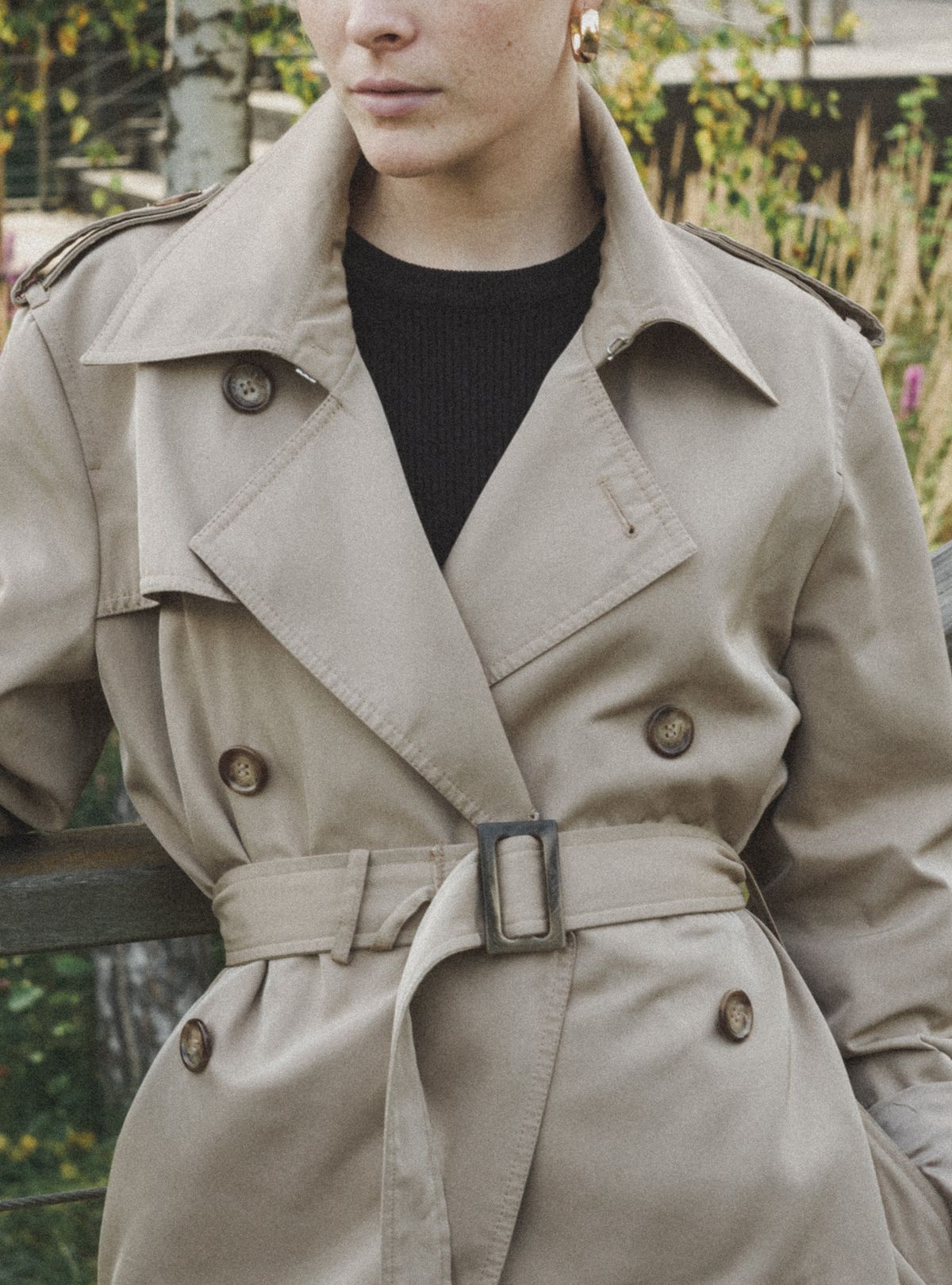
Comprendre l'enveloppe du trench-coat : tissée, résistante à l'eau et légère
Le cœur de tout bon trench est son enveloppe. Les trenchs traditionnels utilisent un gabardine de coton tissé serré, un tissu inventé spécifiquement pour être respirant tout en étant résistant à la pluie. Les versions modernes intègrent souvent du polyester ou une membrane technique qui améliore la déperlance sans ajouter de rigidité. Le résultat est un manteau qui repousse une pluie légère et sèche rapidement, tout en se pliant et en bougeant avec vous au lieu de vous contraindre.
Le poids est important pour la garde-robe des femmes rondes, car les manteaux lourds peuvent donner l'impression d'une armure. L'enveloppe d'un trench est suffisamment légère pour que vous puissiez le porter ouvert, le laisser flotter, et vous sentir toujours libre de vos mouvements. Lorsque vous choisissez des trench-coats grandes tailles, recherchez un tissu avec un peu de corps pour que le manteau conserve sa forme autour des épaules et des hanches, mais pas trop pour qu'il ne devienne pas une tente. Une gabardine de poids moyen ou un tissage de type ponte trouve généralement le bon équilibre.
Lire l'étiquette du tissu
N'hésitez pas à vérifier la composition. Une forte teneur en coton donne une sensation classique et respirante ; un mélange de polyester résiste aux plis et repousse l'eau plus agressivement. Si vous vivez dans un endroit où il pleut fréquemment, penchez pour les mélanges traités. Si vous voulez ce drapé traditionnel, la gabardine de coton est votre amie, bien qu'elle puisse nécessiter un rafraîchissement avec un spray déperlant chaque saison.
Doublure et respirabilité
De nombreux trenchs incluent une doublure partielle ou complète qui aide le manteau à glisser sur les tricots sans s'accrocher. Une doublure en cupro ou en bemberg est fraîche et lisse ; une doublure en polyester est durable et abordable. Quoi qu'il en soit, une doublure empêche la coque de coller, ce qui est un petit confort bien réel lorsque vous superposez des vêtements tout au long d'une longue journée.
La longueur est une autre considération discrète. Un trench qui arrive au niveau du genou est le plus polyvalent, facile à porter aussi bien sur des robes que sur des pantalons, tandis qu'une version plus longue qui tombe à mi-mollet donne un look plus dramatique et vous garde plus au sec en cas de forte pluie. Un trench plus court, s'arrêtant aux hanches, est plus sportif et se marie bien avec les silhouettes à jambes larges très populaires actuellement. Aucune de ces longueurs n'est plus correcte qu'une autre ; la bonne est simplement celle qui vous donne envie de porter le manteau.
La ceinture et la taille : définir plutôt que cacher
C'est là que le trench gagne sa réputation. La ceinture à nouer n'est pas un artifice pour minimiser votre silhouette ; c'est un outil pour marquer votre taille et créer une ligne de sablier flatteuse selon vos propres termes. Lorsque vous serrez la ceinture à un endroit confortable, généralement la partie la plus étroite de votre torse, le tissu au-dessus et en dessous tombe en plis doux qui suivent votre corps au lieu de l'aplatir.
Pour les trench-coats grandes tailles, la ceinture fait un vrai travail. Une ceinture amovible ou ajustable vous permet de décider quel degré de serrage vous convient. Certains jours, vous la voulez ajustée et structurée ; d'autres jours, vous la voulez nouée lâchement dans le dos pour que le manteau flotte. Il n'y a pas de serrage correct, seulement ce qui vous fait vous sentir vous-même. L'essentiel est d'utiliser la ceinture pour indiquer où se trouve votre taille, et non pour comprimer quoi que ce soit.
Où placer la ceinture
La plupart des corps semblent équilibrés avec la ceinture à la taille naturelle, à peu près au niveau du nombril. Si votre torse est plus court, essayez un pouce en dessous de la taille naturelle pour allonger la ligne. Si vous portez plus au niveau de la section médiane, un nœud plus lâche signale toujours la taille sans pression. L'objectif est une légère emphase, un "voici ma taille" visuel qui fonctionne avec vos courbes.
Styles de nœuds qui vous vont bien
Un nœud classique sur le devant donne un air féminin et soigné. Un nœud tiré sur le côté a l'air décontracté. Enrouler la ceinture pour la nouer dans le dos donne un devant plus net et permet au manteau de s'ouvrir en un drapé spectaculaire. Essayez les trois devant un miroir, non pas pour juger votre corps mais pour trouver la silhouette qui vous fait sourire.
Double boutonnage ou simple boutonnage : lequel convient à votre silhouette
La fermeture avant est l'une des décisions visuelles les plus importantes concernant les trench-coats grandes tailles. Un devant à double boutonnage a deux rangées de boutons et un chevauchement plus large, ce qui crée une forte ligne verticale et un peu de structure supplémentaire sur la poitrine. Un devant à simple boutonnage est plus simple, avec une seule rangée de boutons et un devant plus net et moins chargé.
Pour les silhouettes rondes, le double boutonnage peut être magnifique car les panneaux superposés ajoutent une forme intégrée et les rangées de boutons attirent le regard vers le haut et vers l'intérieur. Le risque est le volume au niveau de la fermeture si le tissu est lourd, alors choisissez une coque plus légère si vous aimez ce look. Les trenchs à simple boutonnage sont plus minimalistes et plus faciles à porter ouverts sans que le devant ne flotte, ce que certaines personnes préfèrent pour un confort toute la journée.
Équilibrer les épaules
Quel que soit votre choix, prêtez attention à la couture de l'épaule. Elle doit reposer sur le bord de votre épaule, et non glisser le long de votre bras. Une couture bien placée donne à l'ensemble du manteau un aspect intentionnel, que le devant soit chargé de boutons ou discrètement uni.
Épaulettes et détails
Les épaulettes traditionnelles sur les épaules sont décoratives mais élargissent également visuellement le haut du corps, ce qui peut équilibrer des hanches plus larges. Si vous aimez cette proportion équilibrée, gardez les épaulettes. Si vous préférez une épaule plus épurée, de nombreux trenchs modernes les omettent, et c'est tout à fait dans le style.
La taille et l'espacement des boutons sont plus importants qu'il n'y paraît. Des boutons plus grands donnent une impression de confiance et de tradition, et sont plus faciles à attacher avec des doigts froids, tandis que des boutons plus petits et plus rapprochés donnent un aspect raffiné et moderne. Pour les trench-coats grandes tailles, un bouton qui tient solidement sans tirer sur le tissu est le signe d'un manteau confectionné avec soin. Si le devant baille ou si les boutonnières forcent, c'est la construction du manteau qui parle, pas votre corps, et il vaut la peine d'en trouver un qui se ferme proprement.
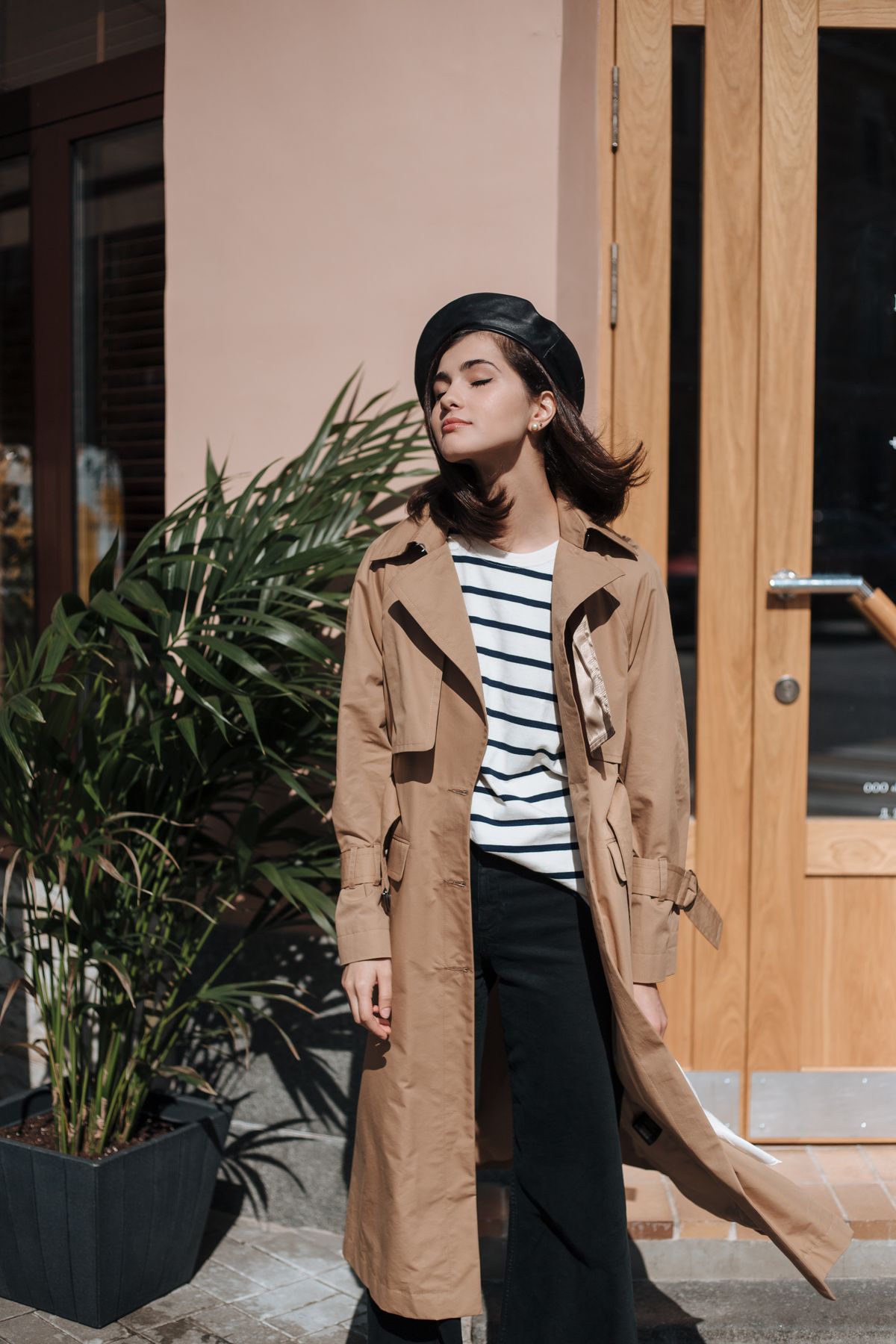
Rabat tempête, revers et mécanique du col
Un trench est truffé de petits détails d'ingénierie qui le distinguent d'un simple imperméable. Le rabat tempête est le panneau de tissu supplémentaire sur le haut du dos et les épaules qui dévie la pluie du corps. Le rabat pistolet, une pièce plus petite sous le col, est historique mais ajoute toujours un look superposé et intentionnel. Ensemble, ils sont la raison pour laquelle un trench se débarrasse d'une averse qui tremperait une veste en jean.
Les revers et le col sont l'endroit où vous contrôlez votre décolleté. Portés ouverts, les larges revers créent un V qui allonge le torse et encadre le visage. Relevé contre le vent, le col protège votre cou et ajoute une touche de drame. Pour les trench-coats grandes tailles, un col qui tient et un revers qui reste plat sans bâiller est à privilégier, car un bâillement au niveau de la poitrine est le moyen le plus rapide pour qu'un manteau cesse d'être perçu comme de qualité.
L'empiècement et la fente arrière
Recherchez une couture d'empiècement sur le haut du dos, qui donne de la forme au manteau sans tirer. Une fente centrale au dos vous permet de marcher et de vous asseoir librement, une petite grâce lorsque vous portez le trench toute la journée. Ce sont ces caractéristiques discrètes qui donnent au trench l'impression d'être conçu plutôt qu'assemblé.
Pattes de serrage aux poignets et fonction
Les pattes de serrage réglables aux poignets ne sont pas seulement décoratives. Serrez-les pour empêcher la pluie de couler le long de vos bras ou pour retrousser la manche pour un look plus décontracté. Une telle fonctionnalité fait partie du charme du trench : tout ce qui est beau a aussi une utilité.
Superposer un trench sur des tricots et des blazers
L'une des joies des trench-coats grandes tailles est leur capacité à être superposés avec élégance. Parce que la toile est légère, vous pouvez porter un pull épais ou même un blazer en dessous sans que le manteau ne fasse ballon. Le trench devient la dernière couche, prête pour le temps, qui lie votre tenue.
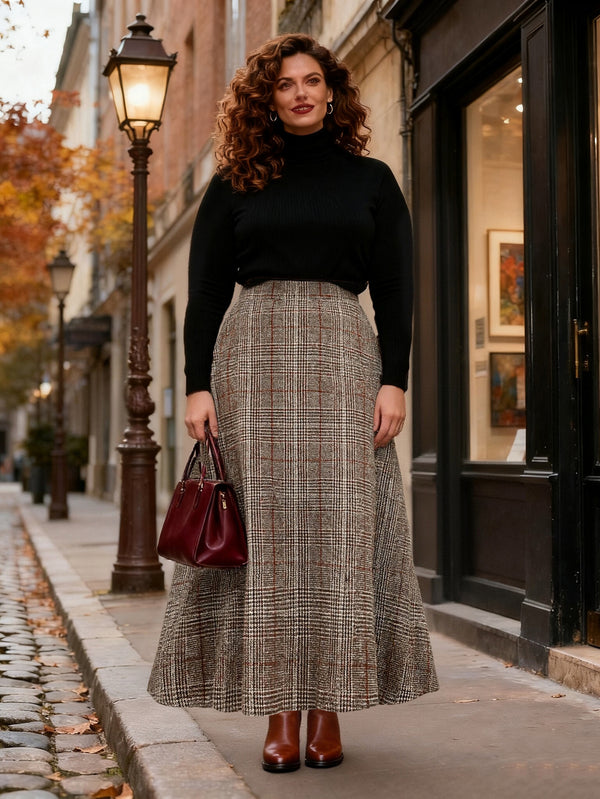
Essayez-le sur un col roulé fin et l'un de nos bas grandes tailles pour un look soigné en semaine qui passe facilement du bureau au dîner. La structure du trench équilibre la douceur des tricots, vous offrant un confort douillet avec une touche d'élégance. Les jours plus frais, superposez le trench sur l'un de nos pantalons larges grandes tailles et un blazer structuré ; la jambe large ajoute du mouvement à l'ourlet tandis que le manteau maintient l'ensemble harmonieux en haut.
Poids des tricots qui fonctionnent
Les gros tricots torsadés conviennent sous un trench à condition que le manteau soit taillé avec de l'aisance aux bras. Si vous aimez les pulls oversize, prenez une taille au-dessus pour le trench ou choisissez un modèle avec des manches raglan ou des épaules tombantes pour faciliter la superposition. Un tricot plus léger en mérinos ou en coton est le choix quotidien le plus sûr et empêche le manteau de serrer dans le dos.
Jeu de couleurs en dessous
Un trench camel ou pierre est lumineux sur des tricots aux couleurs de pierres précieuses. Un trench noir reste élégant sur des neutres. Parce que le trench est une toile neutre, les couleurs que vous choisissez en dessous s'expriment, ce qui en fait l'une des pièces les plus polyvalentes que vous puissiez posséder.
N'oubliez pas les chaussures. Un trench se marie à merveille avec des bottines, des baskets élégantes ou des mocassins, et l'ourlet ouvert laisse apparaître juste assez de vos chaussures pour les intégrer à l'ensemble. Les jours de pluie, une chaussure fermée vous maintient pratique, tandis qu'une botte à talons ajoute de la hauteur et de l'élégance pour le soir. Le trench est indulgent ici : comme ses lignes sont épurées, presque toutes les chaussures que vous aimez déjà se sentiront à l'aise en dessous.
Prêt pour la pluie et compactable pour les intempéries de transition
L'automne et le printemps sont des saisons aux ciels changeants, et les trench-coats grandes tailles sont conçus précisément pour ces temps intermédiaires. L'enveloppe résistante à l'eau gère une averse passagère, tandis que la légèreté signifie que vous ne transpirez pas dès le retour du soleil. C'est un vêtement d'extérieur pour le trajet, le marché fermier, la marche pour le déjeuner, pas pour une tempête de neige glaciale.
La capacité à être rangé est un super-pouvoir discret. De nombreux trenchs, surtout ceux en mélanges techniques, peuvent être roulés ou pliés dans un sac fourre-tout pour le voyage. Jetez-en un dans la voiture ou votre sac de travail et vous êtes prête pour une météo indécise. Même un trench classique en gabardine de coton, bien que moins compactable, se drapera joliment sur un bras lorsque la pluie s'arrêtera, pour que vous ne soyez jamais coincée à porter un volume mouillé.
Pensez au trench comme à votre police d'assurance quotidienne contre les intempéries gênantes. En avoir un à la porte signifie que vous arrêtez de vérifier le radar et commencez à vous faire confiance pour gérer tout ce que le ciel fait. Cette aisance est une forme de confiance en soi, et c'est l'une des raisons pour lesquelles tant de femmes rondes reviennent au trench saison après saison. Il vous demande très peu et vous apporte beaucoup d'élégance.
Entretien et réimperméabilisation
Pour maintenir les performances de la coque, réappliquez un spray déperlant doux une ou deux fois par saison, surtout après le lavage. Vérifiez toujours l'étiquette d'entretien ; de nombreux trenchs préfèrent un cycle délicat en machine ou un nettoyage professionnel. Un peu d'entretien protège votre investissement et maintient le manteau impeccable pendant de nombreuses saisons de transition.
Quand choisir le trench plutôt qu'une doudoune
Optez pour le trench lorsque la température est douce, que la pluie est légère ou que vous souhaitez une silhouette plus nette. Gardez la doudoune isolée épaisse pour les véritables coups de froid. Savoir quel manteau convient à la journée est le moyen le plus simple de rester confortable et stylée sans trop réfléchir à votre garde-robe.
Foire aux questions
Les trench-coats grandes tailles sont-ils suffisamment chauds pour l'hiver ?
Seuls, les trenchs sont des pièces de transition destinées aux temps doux de l'automne et du printemps, pas aux grands froids. Ils sont résistants à l'eau et légers plutôt que fortement isolés. Pour une vraie chaleur hivernale, superposez un trench sur un tricot chaud ou gardez votre doudoune isolée pour les jours les plus froids. Le trench excelle lorsque vous voulez une protection contre la bruine et une silhouette élégante sans volume.
Comment un trench-coat doit-il s'adapter à un corps tout en courbes ?
Recherchez une couture d'épaule qui repose sur le bord de votre épaule, suffisamment d'espace au niveau de la poitrine et des hanches pour pouvoir superposer confortablement, et une ceinture que vous pouvez nouer à votre taille naturelle. Le manteau doit suivre votre forme, et non la combattre. Si vous aimez les pulls épais, choisissez une taille avec de l'aisance aux bras ou un modèle avec des épaules tombantes.
Puis-je porter un trench-coat ouvert plutôt que ceinturé ?
Absolument. Le porter ouvert donne un drapé décontracté et fluide et est merveilleusement confortable pour une tenue de tous les jours. Vous pouvez également nouer la ceinture dans le dos pour un devant plus net. La ceinture est facultative ; le manteau a l'air intentionnel dans les deux cas, alors choisissez ce qui vous fait vous sentir confiante.
Quelle est la différence entre un trench et une doudoune ?
Un trench utilise une enveloppe tissée, résistante à l'eau, façonnée avec une structure, une ceinture et des détails anti-tempête pour la pluie légère et les intempéries de transition. Une doudoune s'appuie sur un rembourrage isolant pour emprisonner la chaleur dans des conditions froides. Les deux sont utiles, mais le trench est votre incontournable pour les jours plus doux et plus humides lorsque vous voulez une silhouette raffinée plutôt qu'une chaleur maximale.