Silicone stay up stockings solve one very specific problem: how to wear elegant hosiery with no garter belt, no straps and nothing cutting into your waist. The answer lives in a narrow band of lace backed with silicone, and once you understand how that band works, choosing and caring for silicone stay up stockings becomes far simpler. This guide takes the grip band apart from the inside out, explains denier and stretch, shows how to choose the right top width for fuller thighs, and walks through putting them on, taking them off and washing them so the silicone keeps its hold season after season.
What Stay-Up Stockings Actually Are
Stay-up stockings are hosiery that holds itself in place on the thigh with no suspender straps and no garter belt. The entire mechanism sits in the top band, which is usually a strip of stretch lace with silicone applied to the inside face. Everything else about the stocking is standard hosiery construction, which is why a good pair feels like ordinary tights from the ankle up.
The three ways to hold hosiery up
There are only three practical methods: a garter belt with straps, a wide band of elasticated lace worn plain, and a lace band backed with silicone. The first transfers holding force to your waist. The second relies on band tension alone and works best on legs that do not narrow sharply. The third combines a wide band with a gripping surface, which is why it holds so well without any straps at all.
Where the silicone band sits
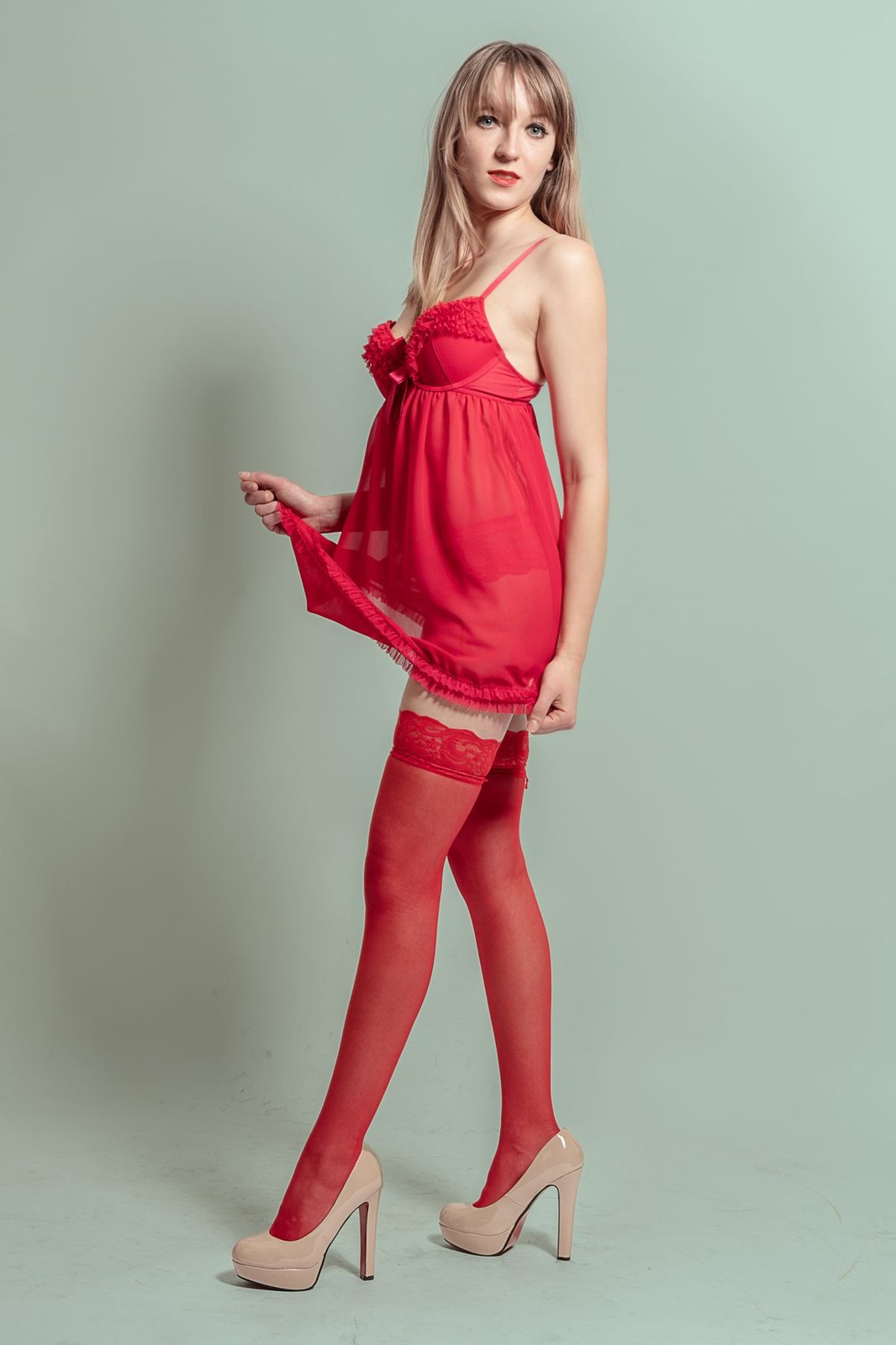
On a correctly sized pair, the band sits on the mid to upper thigh, well above the knee and comfortably below the crease where the leg meets the hip. That position matters. Sit it too low and it rides on the narrowest, most mobile part of the leg, where any band will creep. Sit it too high and it meets the softer crease of the upper thigh, where silicone has less firm surface to grip.
What "stay up" does not mean
Stay-up does not mean permanently welded. It means the stocking holds itself through a normal day of walking, sitting and standing without straps. Take them off and put them on repeatedly, or wear them over a heavy body lotion, and even a good band will lose some of its hold. Understanding that keeps expectations realistic, and the care tips later in this guide are exactly what keep performance at its best. It also helps to remember that stay-ups are designed for the thigh, not for the calf or the knee, so the band should never be pulled down to sit lower in an attempt to feel more secure.
The Lace Grip Band: A Close Look at the Silicone
The band is the whole technology. Everything else is fabric, and fabric you can already judge by touch. So it is worth looking closely at what that strip of silicone is actually doing.
How silicone grips
Silicone is a rubber-like material that creates high friction against skin without being sticky. Pressed gently against the thigh, it resists sideways movement far better than plain elastic does, so the band stays where you place it. It is also skin-friendly, flexible and stable, which is why it is the standard choice for medical wear and for hosiery that has to hold without straps.
Why it is applied in dots and lines
You will usually feel the silicone as a pattern of small dots, short lines or a fine mesh rather than one solid strip. That is deliberate. A pattern flexes with the lace instead of cracking along a single fold line, allows a little air to pass so the skin underneath does not sweat, and gives the band several independent contact points. If one dot lifts slightly, the rest keep working.
The lace on the outside
The lace face is doing more than decoration. It gives the band its structure so it does not roll, spreads the holding force across the full width so no single point presses hard, and provides the stretch that lets the band follow the shape of your thigh as you move. A well-made band is generally three to five centimetres deep; a shallow band has to work much harder for the same result.
Why Silicone Holds Without a Garter Belt — and How It Compares
The most common question about this style is simply whether the silicone really works. The second is how it stacks up against the alternatives most people already own.
Stay-ups versus garter belts
A garter belt attaches to the stocking with metal or plastic clips and holds it up with straps under tension. The clips never slip, but the belt has to sit snugly at the waist, the straps have to be adjusted individually, and they can show under close-fitting clothing. Stay-ups remove all of that. There is no waistband to fasten, nothing to adjust and no hardware to work around, which makes them quicker to wear and invisible under a dress.
Stay-ups versus tights
Tights cover the whole leg and the torso in one piece, which makes them warm and simple but also means a waistband and a full leg of fabric. Stay-ups stop in the middle of the thigh, need no waistband, and let you choose your own underwear freely. They are also easier to manage in a bathroom away from home. On a warm day, or under a dress with a fitted waist, stay-ups are often the more comfortable answer.
When a garter belt still makes sense
Garter belts still earn their place in two situations: when you want very high, decorative straps as part of a look, and when you are wearing stockings for many hours with a lot of movement and want the mechanical certainty of a clip. Many people keep both and choose by outfit. For everyday elegance with the least fuss, though, stay-ups win on speed and comfort, and they are especially kind to anyone who finds a snug waistband uncomfortable after a long meal or a full day at a desk.
Denier, Stretch and Recovery Explained
Denier is the number printed on the packet and the number most shoppers read first. It is useful, but it measures only one thing, and it is not the thing that keeps silicone stay up stockings on your leg.
What denier actually measures
Denier describes the weight and thickness of the yarn in the leg. Roughly, 10 to 20 denier is very sheer and dresses the leg lightly; 30 to 40 denier is a semi-opaque everyday weight; 50 denier and up is opaque and noticeably warmer. Denier says nothing about how the top band performs, which is set by the lace and the silicone instead. A 15 denier sheer and a 60 denier opaque can share exactly the same grip band, so never choose a pair on denier alone when hold is your main concern.
Stretch and recovery
Stretch is how far the knit opens; recovery is how well it returns to shape afterwards. Recovery is the one that matters for a wide thigh, because a stocking that stretches but does not spring back will sag at the ankle and loosen at the band by mid-afternoon. Look for a healthy elastane content and check that the fabric contracts firmly when you release it.
Choosing a weight for the season
Match the denier to the weather and to what you are wearing over it. In early autumn, 15 to 20 denier keeps the look light and works beautifully with a dress and heels. As the temperature drops, move to 30 to 40 denier, which is still dressy but noticeably warmer. For deep winter, 50 denier and above adds real insulation and reads as a textured, opaque finish. A small wardrobe of two weights covers almost every occasion in the year.
Sheer versus opaque top bands
Most bands are denser than the leg of the stocking, which is normal and intentional: the band needs body to hold the silicone and to avoid rolling. A slightly heavier-looking band is a sign of good construction, not a flaw. If you want the band to read as a design feature, choose a lace with a distinct pattern; if you want it to be quiet under clothing, choose a fine mesh lace close to your skin tone.
Finding the Right Top Width for Fuller Thighs
This is the single most important decision with stay-up stockings, and it is the reason generic one-size hosiery so often fails plus size shoppers.
Measure your upper thigh properly
Measure the circumference of the leg at the point where you want the band to sit, usually the fullest part of the mid thigh. Use a soft tape, keep it level all the way around, and do not pull it tight. Then compare that number to the brand's size chart and buy to the thigh, not to your dress size. If you are between sizes on a fuller thigh, going up gives a wider band and a gentler grip, which holds better than a smaller band under strain.
Band depth matters as much as band tension
A deep band spreads the same holding force across more skin. That means it can use less tension for the same grip, which is exactly why it stays comfortable for hours. Depth is what you should be paying for on a fuller thigh. Our plus size thigh high stockings are built with a deeper band for this reason.
Signs the band is the wrong size
The band is too small if it leaves a deep mark within an hour, if it rolls down into a thin cord, or if it needs adjusting every time you stand up. It is too large if it slides without resistance as soon as you walk, or if you can easily pinch a fold of loose fabric at the band. Both problems are fixed by a different size, not by pulling harder.
Why the top width matters more than the dress size
Hosiery is often sold by dress size, but a dress size can cover a wide range of thigh measurements. Two people who both wear the same dress size may differ by several centimetres around the thigh. That is why buying to the thigh measurement, or choosing a brand that publishes a thigh range rather than only a clothing size, is the single most reliable way to get a pair of silicone stay up stockings that genuinely stays put.
How to Put Them On and Take Them Off
Handling matters more with silicone than with ordinary hosiery, because the grip surface is the part you are trying to protect.
Putting them on
Sit down, and gather the stocking from the band down to the toe so you are handling a short, loose tube. Slide your foot in, ease the stocking up to the knee, and then unroll it gradually up the thigh. Work slowly and let the fabric settle rather than dragging it upward in one pull. Once the band is on the thigh, press the lace flat with the flat of your hand for a few seconds; that light pressure seats the silicone evenly.
Taking them off
Roll the stocking down from the band rather than peeling it straight off the thigh. Peeling drags the silicone across the skin and pulls at the lace, which is what shortens the life of the band. Roll down to the knee, then slide the rest off the foot. Take a moment to check the band for lint before you put the stockings away.
Small habits that protect the grip
Keep your hands free of lotion and oil when dressing, since both reduce friction where the band meets the skin. Avoid tugging the band upward by its top edge, which stretches the lace out of shape. And if you are getting dressed after a shower, let your skin dry completely, because a damp thigh reduces grip noticeably in the first half hour.
It also helps to check the inside of the band before every wear. A single stray thread, a grain of sand from the beach or a smear of moisturiser can lift the silicone away from the skin along that whole section. A quick wipe with a dry cloth takes a few seconds and keeps the band working at full strength, which is a small habit that pays off over a whole season.
Care and Washing: Keeping the Silicone Grippy
Washing is where most people accidentally shorten the life of a good pair of stay-ups. Silicone is durable, but it does not enjoy heat, harsh detergent or a tumbling drum.
How to wash
Hand wash in cool water with a small amount of gentle detergent or a dedicated hosiery wash. Squeeze the water through the fabric instead of rubbing it, and pay a little attention to the band so any skin oils are lifted from the silicone. If you prefer a machine, use a mesh hosiery bag on a cold, delicate cycle and nothing else heavy in the drum.
Drying and storage
Roll the stockings in a towel to press out excess water, then lay them flat or hang them by the toe to dry away from direct heat. Never put them in a dryer and never dry them on a radiator, since heat is what dulls the silicone surface. Store them flat or loosely rolled, separately from anything with hooks, zips or velcro that could catch the lace.
When to replace them
Expect a well-cared-for pair to keep its grip for a long time. Replace them when the band stays smooth and shiny rather than slightly tacky to the touch, when the lace has lost its spring, or when the band begins to roll during wear. If you rotate two or three pairs rather than wearing the same one daily, each pair lasts considerably longer. A quick look at our stay up stockings collection will show you the band styles that suit your wardrobe best.
Two further care habits are worth building in. First, wash your silicone stay up stockings after every one or two wears rather than leaving them in a pile, because body oils and skin cells settle into the band and blunt the grip over time. Second, keep a spare pair in rotation for long days out: swapping to a fresh pair gives the lace a chance to recover its shape, and the elastic in any hosiery benefits from a day of rest between wears.

Silicone Stay Up Stockings FAQ: Common Questions Answered
Will the silicone band stay up all day on a fuller thigh?
Yes, when the band is deep and correctly sized. A wide band with moderate tension keeps a much firmer hold than a narrow band stretched tight, because it spreads the force across more skin and does not roll. Measure your mid thigh and buy to that number. If a pair of silicone stay up stockings still slips by mid-afternoon, the band is almost always too shallow rather than too loose.
Do I need a garter belt with stay-up stockings?
No. The silicone band holds the stocking on its own, which is exactly the point of the style. A garter belt is only needed if you want decorative straps as part of a look, or if you prefer the mechanical security of clips for an extremely long day.
Why do my stay-ups stop gripping after a while?
Usually because of heat, detergent residue or body lotion. Washing in cool water with a gentle soap, drying away from radiators, keeping the dryer out of the picture, and dressing on dry skin will restore most of the grip. If the band has also gone smooth and lost its spring, it is time for a new pair.
Can I wear stay-up stockings under trousers?
Absolutely. The band sits on the mid thigh and leaves no waistband, so stay-ups are often more comfortable under fitted trousers than tights. Choose a semi-opaque weight so nothing shows through, and make sure the leg is fully dry before you dress.