Denim flared leg warmers are the small detail that turns a plain winter outfit into a complete look. If you have watched the Y2K revival move through denim — the boot-cut flares, the low-slung belts, the faded washes — you already recognise the silhouette. What is less obvious is how genuinely wearable denim leg warmers are for plus-size women who want warmth, a little drama at the ankle and zero fuss. This guide walks through the whole picture: which washes to choose, how to layer denim leg warmers over leggings, jeans and boots, how to keep them from sliding down, and which Y2K styling formulas actually work on a curvy body. No tricks, no shrinking, just well-fitting clothes that you can wear straight out of the parcel.
Why Denim Flared Leg Warmers Are Everywhere Again
Trends return in pieces. First the jeans widened, then the waistbands softened and dropped, then the accessories came back — and the flared leg warmer is the piece that completes the cycle. What makes the denim version different from the knit ones you remember from a decade ago is that it is designed for layering rather than for costume. It reads as denim, wears like a soft knit, and sits exactly where a cropped trouser meets a boot. Three things keep this trend moving.
It solves a real cold-weather gap
Cropped jeans, wide-leg trousers and midi skirts all leave the lower calf exposed. A flared warmer fills that space instantly, which means you can wear the denim you love deeper into autumn and winter instead of packing it away in October. Look through our Y2K leg warmers range and you will see how many of the pieces are built around exactly that gap.
It works with denim you already own
You do not need a new wardrobe. A pair of denim leg warmers in a similar wash to your jeans creates a column of colour from hip to ankle, which reads as intentional and expensive. A contrasting wash creates a deliberate break, which is the more playful Y2K option.
It adds volume exactly where you decide
A flare is a shape you control. Because the volume sits below the calf, it balances an outfit that is fitted through the hip and thigh, and it gives structure to a floaty dress. You choose the amount of drama: a gentle ten-centimetre flare for everyday, a full twenty-centimetre ruffle for a night out.
The 2000s reference, decoded
The original 2000s look was layered and slightly chaotic: a denim skirt over flared jeans, a belt sitting on the hip, a knit cuff at the ankle. You do not have to recreate all of it at once. Choose one reference per outfit — the flare, the low rise, the pastel knit — and let everything else read as modern. That is what keeps a revival trend looking current rather than like fancy dress.
What Makes a Denim Leg Warmer Different From a Knit One
Shopping online is far easier when you know what you are actually buying. A denim warmer is rarely stiff raw denim wrapped around your leg — that would not stay up and it would not be comfortable. In practice the best pairs are built in one of two ways, and both are worth understanding before you order.
Denim-effect knit
This is the most common construction: a chunky ribbed knit dyed and finished to look like vintage denim, often with a subtle marl or fade worked into the yarn. It behaves like a leg warmer, stretches like a sock and is usually machine washable. If comfort comes first for you, start here.
Soft denim with an elasticated cuff
A lighter, softer denim with a little stretch, gathered onto a hidden elastic band at the top and finished with a raw or folded hem. These hold their flare shape better and photograph beautifully, but they need more care in the wash.
What to check in the product photos
Look for a visible rib or knit texture at the cuff, a flat seam where the flare begins, and a hem that has been properly finished rather than left ragged. If a listing shows the warmer standing up on its own like a little boot, it is probably a denim-effect knit with plenty of body — which is exactly what stops the flare collapsing mid-wear. Knowing which build you prefer also tells you how to size: knit versions should feel snug but never tight at the top, while structured versions should grip without leaving a deep mark.
Weight matters more than you think
A heavier warmer with a denser knit adds warmth and keeps its shape, but it can feel bulky inside a tight boot. A lighter warmer is easier to layer and better for autumn, but the flare may collapse if the yarn has no body. If you only buy one pair, choose something mid-weight — warm enough for winter, slim enough to tuck into a boot.
The Wash Guide: Vintage Blue, Faded Grey, Washed Black and Stone
Wash is the fastest way to change the mood of a look, and it is the part of this trend people get wrong most often. Here is how each family behaves in real outfits.
Vintage mid-blue
The safest starting point. Mid-blue matches the majority of jeans, reads as genuinely Y2K and works with almost everything else you already own. Pair it with white trainers and a cropped hoodie for the classic 2000s formula, or with a cream knit dress for something much softer.
Light stone and faded grey
These are the washes that feel closest to the original 2000s denim, and they work best with pastel tops, baby tees and silver jewellery. Faded grey is the quieter option and pairs surprisingly well with black boots and a grey ribbed knit.
Washed black and charcoal
If you want the trend to feel grown-up rather than nostalgic, washed black is the answer. It blends into black leggings and black boots, extending the line of the leg, and it makes bright chunky knits and jewel tones really pop.
Two-tone and patchwork finishes
Splitting the warmer into two denim tones, or adding a contrast cuff, is the bolder choice and suits a maximalist Y2K outfit. Keep everything else quiet: one strong colour, plain boots, no extra prints competing for attention.
One rule keeps this simple. Match the warmer to your boots if you want height, and match it to your jeans if you want length. You can absolutely use both ideas in the same week — this is not a rule that has to last longer than the mirror in front of you.
How to Layer Denim Leg Warmers Over Leggings, Jeans and Boots
Layering is where the look either sings or slides, and the good news is that it comes down to three pairings, each with a slightly different technique. Almost every complaint about denim leg warmers comes down to layering rather than to the product itself.
Over leggings
Full-length leggings are the easiest base because they are smooth and stay put. Pull the warmer up over the legging to just below the knee, then fold the top band down once so it grips the calf rather than the knee. If your leggings are long, tuck the hem into a sock so it does not bunch under the warmer.
Over jeans
This is the real trend moment, and it works best with a straight, boot-cut or flared jean. Choose a warmer that flares wider than your trouser hem so the denim layers outward instead of fighting itself. A cropped jean gives the cleanest result; a full-length jean works beautifully if you place the warmer over the hem rather than underneath it.
Over and into boots
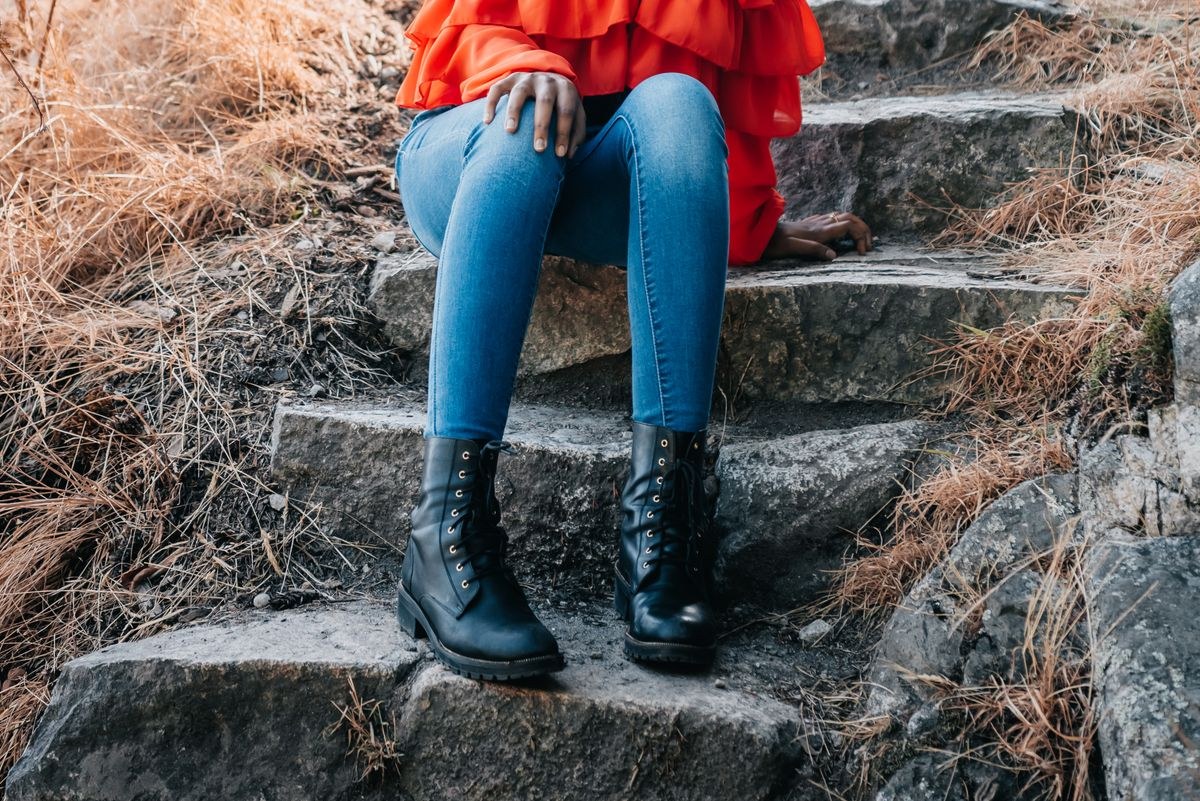
For boots, decide whether the warmer goes over the boot or inside it. Over a mid-calf boot the flare sits on top of the shaft and creates a stacked, textured look. Inside an ankle boot the flare spills over the collar and reads as the top of a taller boot. Two small details make the whole thing look styled rather than thrown on: keep the top band of the warmer parallel to the floor, and make sure both sides sit at the same height on the calf.
The hem rule that fixes everything
If an outfit looks wrong at the ankle, it is almost always an order-of-layers problem. Work from the thickest item outward: tights closest to the skin, then the trouser, then the warmer, then the boot. When the warmer sits directly under a boot shaft it stays put all day, and when it sits over the top of a boot it holds its flare far better because it has something firm to rest on.
Y2K Styling Formulas That Work on a Plus-Size Body
Rather than copying an outfit from a photograph and hoping it translates, use a formula. These four combinations consistently look good, and each one can be adapted to your own proportions in seconds.
Cropped hoodie, low-rise flare jean, matching warmers
The most literal 2000s look. Keep the hoodie cropped at the natural waist or just below it, and choose a jean with enough stretch that the low rise actually sits where you want it to. Choose warmers in the same wash as the jean for a clean, uninterrupted line from hip to ankle.
Baby tee, pleated mini, over-the-knee boots
Volume on volume, balanced by a tall boot. If you prefer more coverage, swap the mini for a denim midi and let the warmers show at the very bottom of the hem. Go for washed black so the warmer reads as part of the boot rather than a separate accessory.
Oversized knit, straight jean, chunky trainers
Your everyday option. The oversized knit gives softness up top, the straight jean gives a clean leg, and the warmers add weight at the ankle to ground all that volume. This is the version to reach for on a cold school-run morning when you still want to look like you tried.
Slip dress, opaque tights, denim warmers
A contrast formula that surprises people. Layer opaque tights under the warmers and let a satin or jersey slip dress fall just above them. It is romantic and a little grungy at once, and it makes a summer dress genuinely wearable in October.
Every one of these works because the flare is doing a job: it balances a fitted top, grounds a soft dress, or continues a wide leg. Pick the formula that matches the mood you want, not the body you think you are supposed to have.
How to Stop Them Sliding, Twisting or Bunching
A leg warmer that has slipped down to your ankle ruins an outfit faster than rain. The fixes are simple, and none of them involve tape on your skin.
Get the top band in the right place
The band should sit on the fullest part of your calf, not in the narrow dip just below the knee. That dip is where gravity wins. Move the warmer down a centimetre or two and it will hold far better all day.
Use the fold-over trick
Fold the top cuff over once, outward, so two layers of knit grip the leg. It looks deliberate and it roughly doubles the friction where you need it.
Pair with a grippy base layer
Sliding usually happens because the base layer is slippery. Opaque tights and cotton leggings grip well; shiny satin-lined leggings do not. If you want the smooth base anyway, add a thin ankle sock underneath the warmer to create traction right at the cuff.
Consider a silicone band
Some pairs come with a silicone strip sewn inside the cuff. If yours does not, a pair of silicone sock-stay bands from the hosiery aisle is a cheap and genuinely effective addition. Wash them with soap after each wear to keep the grip alive.
Twisting is a fit issue rather than a grip issue. If your warmer spirals, it is usually too narrow at the top for your calf, so size up rather than pulling harder. Bunching at the ankle almost always means the warmer is too long for the gap you are working with — fold a single cuff at the bottom, or choose a shorter length next time.
Quick fixes for a warmer that rolls
A rolled cuff is nearly always caused by a band that is too narrow for the calf, which makes the knit curl instead of lying flat. Try folding the cuff outward rather than inward, switch to a wider band, or add a silicone stay band underneath. If the roll continues, the warmer is simply too small — a larger size in the same style will behave completely differently.
Fit, Care and Sizing: Making a Denim Pair Last
Denim-effect leg warmers are tougher than they look, but they reward a little attention with years of wear.
Sizing
Measure the widest part of your calf and compare it with the size chart, not with an assumed letter size. A good warmer should have around two to three centimetres of stretch left in the band. If your measurement falls between two sizes, size up: the knit relaxes over the first few wears, and a slightly looser cuff stays up better than a tight one that rolls.
Washing
Turn them inside out, use a mesh laundry bag, and wash on cold with a gentle cycle. Skip the fabric softener, which coats the fibres and reduces the grip on elastic bands. If the care label allows tumble drying, use the lowest heat; otherwise lay them flat to dry away from direct sun so the dye does not fade unevenly.
Storing
Roll rather than fold. A hard fold across the flare creates a permanent crease that shows the moment you wear them. If you must fold, fold at the cuff, where the knit is densest and springs back fastest.
De-pilling
A cheap fabric shaver restores a marled denim knit in about two minutes. Use short, light passes, and avoid pressing hard on the flare itself, where the knit is thinner and easier to catch.
Looked after this way, a good pair will see you through several winters — which matters, because this trend is not going away quickly.
How to tell a good pair from a cheap one
Three things separate a pair that lasts from a pair that disappoints. First the cuff: a wide, densely knitted band holds up far better than a thin one. Second the seam: flat seams sit smoothly against the leg, while bulky seams twist as you walk. Third the flare: it should be shaped into the knit itself, not added as a separate ruffle that sags after two wears. Check the returns policy too — leg warmers are an accessory where ordering a second size to compare is completely normal.
FAQ: Denim Leg Warmers, Answered
Can I wear denim leg warmers if I have wide calves?
Yes, and they often suit a fuller calf particularly well, because the flare begins below the widest point and balances it. Look for a ribbed knit with plenty of stretch, choose the size that matches your calf measurement rather than your dress size, and position the cuff on the fullest part of the calf so it grips properly.
Do they work over jeans, or only over leggings?
Both. Over leggings they behave like a chunky sock; over a straight or boot-cut jean they read as a layered denim statement. The only hard rule is that the warmer should flare wider than the trouser hem beneath it, so the two layers sit in the correct order. If you want the full range of lengths and washes in one place, browse the leg warmers collection.
What shoes look best with them?
Chunky trainers, platform boots and mid-calf biker boots are the easiest matches. An ankle boot worn underneath the flare gives a stacked look; a tall boot worn over the top gives a smooth, continuous line. Heels work too — just keep the heel slim so the flare stays the widest element in the silhouette.
Are they warm enough for real winter?
A chunky knit pair over opaque or fleece-lined tights is genuinely warm and covers the cold gap between a cropped trouser and a shoe. If you are standing around outside for hours, wear thin thermal socks underneath the tights and the warmer on top, and you will be comfortable well below freezing.
Ready to find your pair? Shop all thigh high socks — plus sizes, striped, fishnet and over-the-knee styles, all in one place.