Pantalon en velours côtelé grandes tailles : Le guide complet des tenues et du style pour l'automne 2026
Aug 04, 2026

Le velours côtelé fait un retour en force cet automne, et honnêtement, il était temps. Si vous avez passé les automnes précédents à regarder tout le monde enfiler des pantalons côtelés riches et nervurés tout en vous demandant si le tissu conviendrait à votre morphologie, ce guide est fait pour vous. Le pantalon en velours côtelé grande taille est l'une des pièces les plus sous-estimées que vous puissiez ajouter à une garde-robe automnale pour femmes rondes – chaud sans être encombrant, structuré sans être rigide, et beaucoup plus tolérant aux mouvements qu'un jean rigide. Le problème est que le velours côtelé a quelques particularités que personne n'explique. Alors, corrigeons cela, de la largeur des côtes à l'usure de l'intérieur des cuisses en passant par les formules de tenues qui font qu'un seul pantalon mérite sa place dans votre placard.
Pourquoi le velours côtelé convient si bien aux corps aux formes généreuses
Il existe un mythe persistant selon lequel les tissus texturés sont risqués sur un corps plus grand – que tout ce qui a une surface visible « ajoute du volume ». Cette idée provient d'une philosophie de style axée sur la réduction, et ce n'est pas ainsi que les vêtements se comportent réellement.
Structure sans rigidité
Le velours côtelé est un tissu à poils coupés : la surface est faite de minuscules cordons de fil surélevés, et ce poil donne du corps au tissu. Sur une silhouette aux formes généreuses, le corps est votre ami, car un tissu avec de la substance glisse sur une hanche ou une cuisse au lieu de s'accrocher à chaque contour. Un pantalon fin et fluide épouse exactement votre corps ; le velours côtelé conserve sa forme à quelques millimètres de la peau, de sorte que la ligne de la jambe est nette et intentionnelle. Il ne s'agit pas de cacher quoi que ce soit – c'est de la mécanique textile.
Le poil absorbe la lumière au lieu de la réfléchir
Les tissus brillants réfléchissent la lumière, ce qui met en évidence chaque couture tendue et chaque ligne de tension. Le poil surélevé du velours côtelé diffuse la lumière doucement, de sorte qu'un pantalon bien ajusté semble plus lisse et plus cher qu'un tissu tissé comparable au même prix. Les petites rides dues à la position assise au bureau se détendent également au lieu de se transformer en plis marqués.
Il assure la transition pendant les semaines délicates
Le début de l'automne est un cauchemar à habiller : quinze degrés au petit-déjeuner, vingt-cinq à l'heure du déjeuner, frais à nouveau à six heures. Le denim semble lourd et le lin semble démodé, mais un velours côtelé de coton de poids moyen respire bien mieux que la plupart des gens ne l'imaginent. C'est pourquoi les pantalons en velours côtelé grande taille fonctionnent si bien en septembre et octobre, lorsque vous voulez avoir l'air d'automne sans avoir trop chaud. Un bon pantalon rehausse également un simple t-shirt d'une manière que les jeans ne font tout simplement pas.
Côtelé 101 : Côtelé fin, moyen et large expliqué
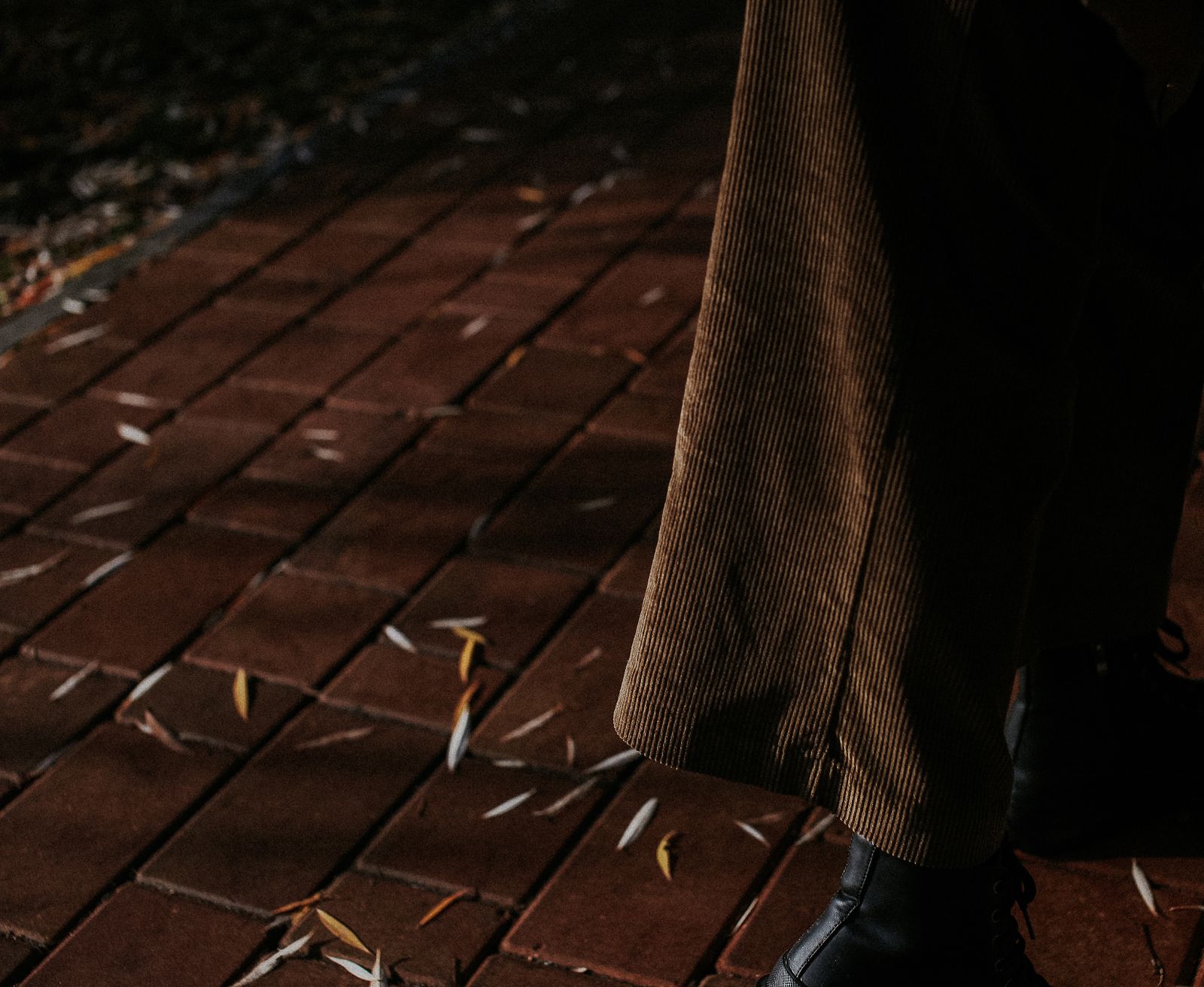
Le côtelé est la spécification la plus importante sur une page produit en velours côtelé, et la plupart des acheteurs le contournent directement. Le numéro du côtelé indique le nombre de côtes, ou de crêtes, par pouce de tissu. Un nombre plus élevé signifie des nervures plus fines ; un nombre plus faible signifie moins de nervures, plus grosses.
Côtelé fin (16–21 côtes, aussi appelé piqué ou velours milleraies)
Nervures étroites et rapprochées. Le côtelé fin est le plus fluide et le moins visible – il se comporte presque comme un sergé doux, ce qui en fait le velours côtelé le plus facile à habiller pour le travail. C'est aussi généralement le plus léger, il convient donc à la fin de l'automne, plus chaude. L'inconvénient : un poil plus court s'aplatit et brille plus rapidement dans les zones de forte friction.
Côtelé moyen (8–13 côtes)
Le juste milieu pour la plupart des garde-robes. Le côtelé moyen est indubitablement du velours côtelé, il a suffisamment de poids pour tomber magnifiquement dans une jambe large ou droite, et survit à une saison complète d'usure réelle. Si vous achetez une paire et que vous voulez qu'elle fasse tout, achetez du côtelé moyen.
Côtelé large (1,5–7 côtes, ou velours jumbo)
Gras, dramatique, très années soixante-dix. Le côtelé large est le plus lourd et le plus chaud, et sur un corps aux formes généreuses, il peut être fantastique – la répétition verticale audacieuse attire le regard le long de la jambe. Deux précautions : il est encombrant aux coutures, il a donc besoin d'une coupe plus ample, et les canaux profonds entre les côtes s'écrasent plus visiblement.
Adapter le côtelé à vos proportions
- Entrejambe plus court ou petite-courbée : le côtelé fin à moyen maintient la répétition visuelle petite.
- Grande et courbée : vous avez l'espace vertical pour porter magnifiquement le côtelé large.
- Cuisse pleine par rapport au mollet : le côtelé moyen dans une jambe large ou droite donne la ligne la plus uniforme.
- Adapté au bureau : le côtelé fin dans une couleur foncée et saturée ressemble presque à un pantalon en laine.
Stretch, Composition du Tissu et Pourquoi 2–4 % d'Élasthanne Compte
Lisez la ligne de composition avant de tomber amoureux d'une photo. Ce détail prédit plus sur la façon dont un pantalon se sent à la huitième heure que presque toute autre chose.
La gamme magique
Recherchez environ 96–98 % de coton avec 2–4 % d'élasthanne, parfois répertorié comme spandex ou Lycra. Ce petit pourcentage fait un travail considérable. Sur un corps aux formes généreuses, le tissu doit parcourir une longue distance sur la courbe de la hanche et de la cuisse, puis revenir. Le 100 % coton rigide n'a aucune élasticité – il tire sur l'assise lorsque vous vous asseyez, s'affaisse au genou en milieu d'après-midi et ne se récupère jamais. Deux à quatre pour cent d'élasthanne vous offrent une élasticité pour s'asseoir, monter les escaliers et croiser les jambes, ainsi que la capacité de retrouver sa forme au lieu de s'affaisser.
Pourquoi plus de stretch n'est pas mieux
Au-delà d'environ 5 % d'élasthanne, le velours côtelé commence à se comporter comme un jegging. Le poil perd de sa netteté, la ligne de jambe devient collante et le tissu s'agrandit tout au long de la journée – une ceinture qui convient à 8h bâille à 14h. Vous perdez exactement la structure pour laquelle vous avez acheté le velours côtelé.
Le poids, et quand le rigide en vaut la peine
Le poids est exprimé en GSM. Environ 250-300 GSM est un velours léger de transition, 320-380 GSM est un vrai pantalon toutes saisons, et au-delà de 400 GSM est un territoire d'hiver lourd. Le poids moyen est le premier achat le plus sûr. Les paires 100% coton rigide vieillissent magnifiquement, mais prenez une taille au-dessus et choisissez une coupe décontractée où l'ajustement ne dépend pas du stretch – jamais une jambe fuselée.
Mécanismes d'ajustement : la taille, la ceinture et la question de l'intérieur de la cuisse
C'est là que la plupart des pantalons échouent sur les corps ronds, et où un peu de connaissance permet d'économiser beaucoup de retours.
La taille : optez pour plus haut que vous ne le pensez
Si vous avez des formes au niveau de la taille – et c'est le cas de la plupart d'entre nous – une taille haute est presque toujours la solution avec les pantalons en velours côtelé grande taille. Recherchez un entrejambe avant d'environ 12 à 14 pouces (30 à 35 cm). Cela se situe au-dessus ou juste au-dessus de votre taille naturelle, la partie la plus étroite et la plus stable de votre torse, donnant à la ceinture quelque chose à quoi s'accrocher au lieu de descendre et de rouler sous votre ventre. Une taille moyenne de 10 à 11 pouces (25 à 28 cm) peut fonctionner si vous avez des formes plus basses, mais elle se situe au niveau de la partie la plus large d'un ventre doux, ce qui est exactement là où les ceintures serrent.
La construction de la ceinture est la vraie histoire
- Une ceinture profilée plutôt qu'une bande droite – une bande incurvée suit l'angle de la taille à la hanche et réduit considérablement l'espace arrière.
- Élastique partiel à l'arrière, la meilleure caractéristique des pantalons grande taille. Il absorbe la différence taille-hanches tout en conservant une façade plate.
- Au moins 1,5 pouce de large. Les bandes étroites concentrent la pression sur une ligne et serrent.
- Des poches plates. Si elles bâillent sur le cintre, elles bâillent encore plus sur votre hanche.
Si votre différence taille-hanche est significative, achetez à la plus grande mesure et faites ajuster la taille. C'est une retouche bon marché qui transforme un pantalon acceptable en un pantalon sur mesure.
L'usure de l'intérieur de la cuisse : le sujet dont personne ne parle
Voici la conversation honnête. Si vos cuisses se touchent, et c'est le cas de l'écrasante majorité des gens, la zone intérieure de la cuisse de tout pantalon subit un frottement constant. Sur le velours côtelé, ce frottement aplatit le poil – les côtes s'écrasent, le velours s'use, et vous obtenez une tache brillante et plus claire sur l'intérieur de la cuisse supérieure. Ce n'est pas un défaut et vous ne faites rien de mal ; c'est la physique d'un tissu à poils coupés qui subit une abrasion répétée. Ce qui le réduit réellement :
- Choisissez une coupe plus ample au niveau de la cuisse. Les formes larges, droites et en baril permettent au tissu de pendre loin de la jambe au lieu d'être coincé entre vos cuisses à chaque pas. C'est de loin la solution la plus efficace.
- Privilégiez le côtelé moyen. Un poil plus haut a plus de matière à perdre avant que l'usure ne se manifeste.
- Choisissez des couleurs qui camouflent la brillance. L'olive, la rouille, le camel et l'ardoise masquent l'aplatissement bien mieux que le noir ou le marine.
- Portez une couche de base lisse. Des shorts fins sans couture réduisent considérablement le frottement peau sur tissu.
- Faites tourner vos paires. Les fibres ont besoin de temps pour récupérer ; trois jours de suite accélèrent l'écrasement.
Coupes qui fonctionnent : Large, Droit, Évasé, Tonneau et Fuselé
La silhouette détermine comment une paire se porte réellement sur votre corps. Voici une évaluation directe de chacune, basée sur le comportement du velours côtelé plutôt que sur des règles concernant ce que l'on « devrait » porter.
Jambe large
Le choix le plus solide dans l'ensemble. Le poids du velours côtelé fait qu'une jambe large tombe en une colonne verticale nette au lieu de flotter. Il offre un dégagement maximal des cuisses, ce qui résout le problème de frottement, et crée une longue ligne ininterrompue de la taille au sol. Obtenez la bonne longueur – l'ourlet doit presque effleurer le sol.
Jambe droite
Le plus polyvalent et le plus facile à coiffer. Une vraie coupe droite a la même largeur du genou à l'ourlet, équilibrant une hanche plus pleine sans le côté dramatique d'une jambe large. C'est le pantalon que vous portez au bureau, au dîner et pour faire des courses.
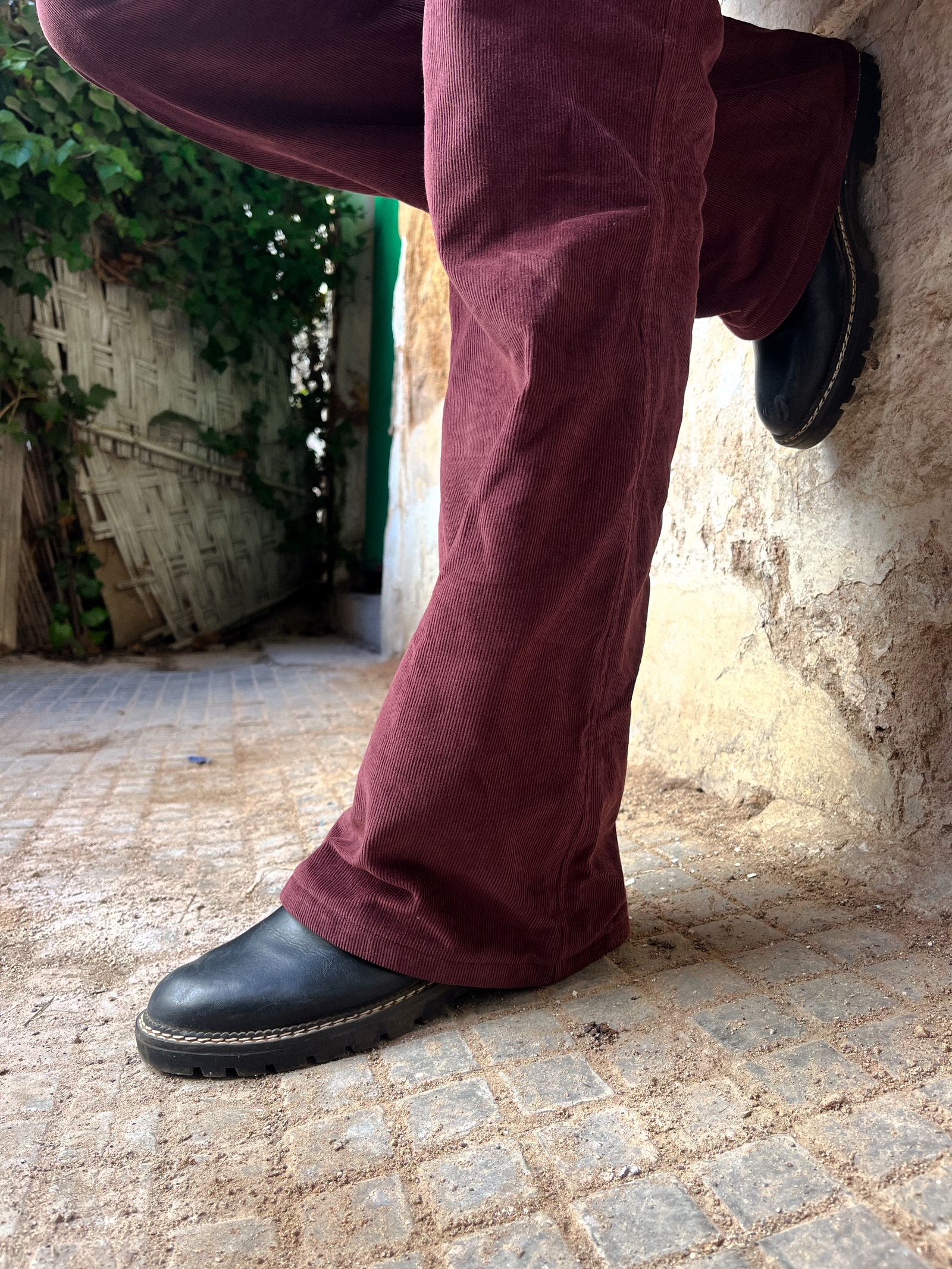
Évasé et bootcut
Fantastique si vous aimez l'énergie seventies que le velours côtelé véhicule naturellement. Une ouverture évasée à partir du genou équilibre une hanche et une cuisse pleines et permet de glisser une botte en dessous. Il faut de la longueur, donc si vous êtes plus petite, recherchez un entrejambe petite plutôt que de faire un ourlet – raccourcir un évasé modifie la forme de l'ouverture.
Jambe tonneau et incurvée
Le favori actuel, et véritablement bien adapté aux courbes. Une jambe tonneau est ample au niveau de la cuisse, s'incurve vers l'extérieur, puis se resserre légèrement à la cheville. La structure du velours côtelé maintient exceptionnellement bien cette forme sculpturale : un espace généreux aux cuisses, avec une cheville définie qui empêche le look de paraître informe.
Fuselé et slim
La coupe la plus délicate. Un pantalon en velours côtelé fuselé nécessite 3 à 4 % d'élasthanne et une mesure de cuisse généreuse, sinon il tirera horizontalement sur le devant et s'usera le plus rapidement au niveau de l'entrejambe. Si vous aimez une jambe slim, choisissez un velours côtelé fin et prenez une taille au-dessus au niveau des hanches. Comparer les mesures de la cuisse et de l'entrejambe sur une gamme complète de pantalons grande taille dans toutes les coupes et toutes les tailles est le moyen le plus rapide de trouver votre point de référence.
Couleurs au-delà du marron et quatre formules de tenues complètes
Le velours côtelé est souvent associé au marron dans l'imagination de la plupart des gens. Le marron est très bien, mais s'arrêter là, c'est manquer le meilleur de ce que ce tissu fait avec la couleur – le poil donne à chaque nuance une profondeur inhabituelle, car la lumière frappe le dessus de chaque côte tandis que l'ombre se niche entre elles. Achetez votre pantalon en velours côtelé grande taille dans une couleur que vous voulez réellement intégrer à vos tenues.
Couleurs à rechercher
- Olive et mousse : la couleur non neutre la plus polyvalente, s'accordant avec le noir, le crème, la rouille et le denim.
- Rouille, brique et orange brûlé : la déclaration automnale par excellence, facile avec le crème ou le gris anthracite.
- Crème et os : inattendu et moderne ; un velours côtelé clair avec un tricot épais est un look de transition superbe.
- Bleu ardoise et sarcelle poussiéreux : des alternatives plus fraîches au marine qui dissimulent bien l'usure du poil.
- Prune et bordeaux : riches et élégants sous un manteau noir ou camel.
- Gris anthracite : l'option la plus appropriée pour le travail après le noir, et moins sujette à la brillance.
Formule un : la journée de travail
Un pantalon en velours côtelé fin gris anthracite ou olive foncé, coupe droite. Rentrez un pull à col rond en mérinos ou une chemise en popeline impeccable, ajoutez un blazer long dans un neutre contrastant, et terminez avec une bottine à bout pointu ou un mocassin. Le fait de rentrer le haut est important – cela marque la taille et donne à la tenue un aspect plus ajusté que décontracté.
Formule deux : le week-end
Pantalon en velours côtelé rouille ou camel à jambe large, un pull en maille torsadée oversize rentré à moitié sur le devant, une veste en jean ou en shearling, et des baskets blanches ou des bottes à semelle crantée. Le fait de rentrer le haut à moitié montre où se trouve votre taille sans rentrer tout le pull.
Formule trois : soirée
Un pantalon en velours côtelé noir ou bordeaux à jambes larges avec une camisole en satin ou en velours, une veste courte et une botte à talons. Le velours côtelé associé à un tissu brillant crée un contraste de textures luxueux, et bien plus intéressant qu'un autre pantalon noir.
Formule quatre : décontracté facile
Pantalon en velours côtelé crème ou ardoise à jambes amples, un t-shirt uni à manches longues, une chemise en flanelle déboutonnée et des baskets discrètes. Zéro effort, mais l'intention est là.
Règles de chaussures qui tiennent toujours
- Jambe large et évasée : nécessitent de la hauteur ou une semelle épaisse – les plateformes, les bottes à talons ou les semelles crantées empêchent l'ourlet de toucher le sol.
- Jambe droite : la plus flexible ; baskets, mocassins, bottines et chaussures plates conviennent toutes.
- Tonneau et fuselé : dévoilent la cheville, donc une chaussure basse, une mule ou une botte élégante est préférable.
- Associez la chaussure à la couleur de l'ourlet pour une ligne de jambe plus longue ; contrastez lorsque vous voulez que la chaussure soit au centre de l'attention.
Entretien, lavage et dépannage de l'ajustement
Le velours côtelé n'est pas exigeant, mais il est spécifique. Traitez-le comme un pantalon en coton ordinaire et vous écraserez le poil en une saison.
Laver sans abîmer le velours
- Retournez-les à chaque fois. Cela protège le velours de l'abrasion contre le tambour.
- Eau froide, cycle délicat. La chaleur détend l'élasthanne et rétrécit le coton.
- Lavez avec des poids similaires. Du velours côtelé chargé de serviettes signifie des peluches entre chaque côte.
- Évitez l'assouplissant. Il recouvre les fibres et aplatit le velours – utilisez plutôt du vinaigre blanc dans le rinçage.
- Lavez moins souvent. Aérez-les la nuit et nettoyez les taches ; trois ou quatre utilisations entre les lavages est raisonnable.
Séchage et ravivement du poil
Séchez à l'air libre chaque fois que vous le pouvez – suspendez-les par la taille, à l'envers, et lissez les jambes humides. La chaleur élevée est le moyen le plus rapide d'aplatir définitivement le velours côtelé, donc si vous devez le sécher en machine, utilisez le réglage le plus bas. Pour raviver les zones écrasées, tenez un défroisseur à dix à quinze centimètres du revers, laissez la vapeur pénétrer, puis brossez doucement avec une brosse à vêtements douce dans le sens du poil. Ne jamais appliquer un fer chaud directement sur l'endroit.
Dépannage de l'ajustement
- Écartement à l'arrière de la taille : la bande est droite. Faites-la reprendre, ou recherchez une bande incurvée avec élastique à l'arrière.
- Lignes de tension horizontales sur l'avant de la cuisse : la cuisse est trop petite. Prenez une taille au-dessus et faites reprendre la taille.
- La ceinture roule : la taille est trop basse. Optez pour une taille avant de 30 à 35 cm.
- Plissement derrière le genou : longueur excessive. Raccourcissez l'entrejambe d'un pouce (2,5 cm).
- S'étire l'après-midi : trop d'élasthanne, ou le tissu est trop léger. Recherchez un grammage plus élevé.
- La couture d'entrejambe tire vers l'avant : la taille arrière est trop peu profonde pour vos fesses.
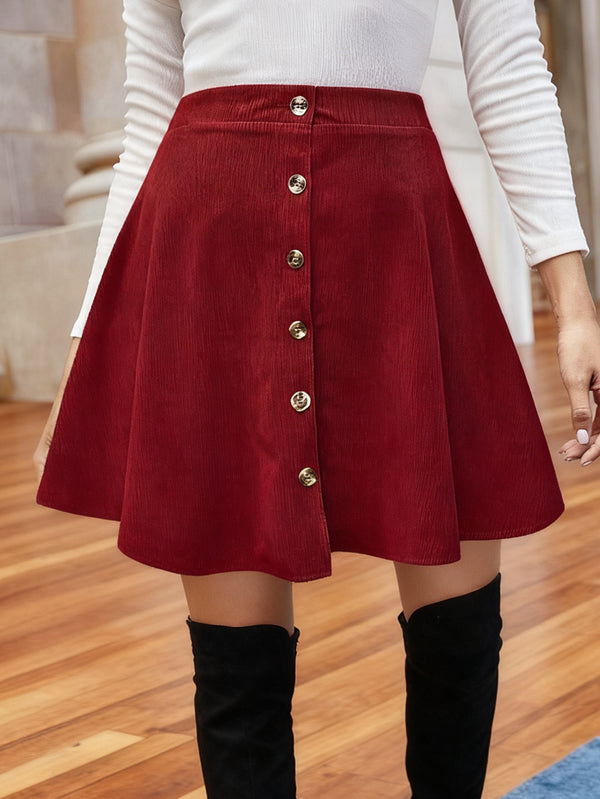
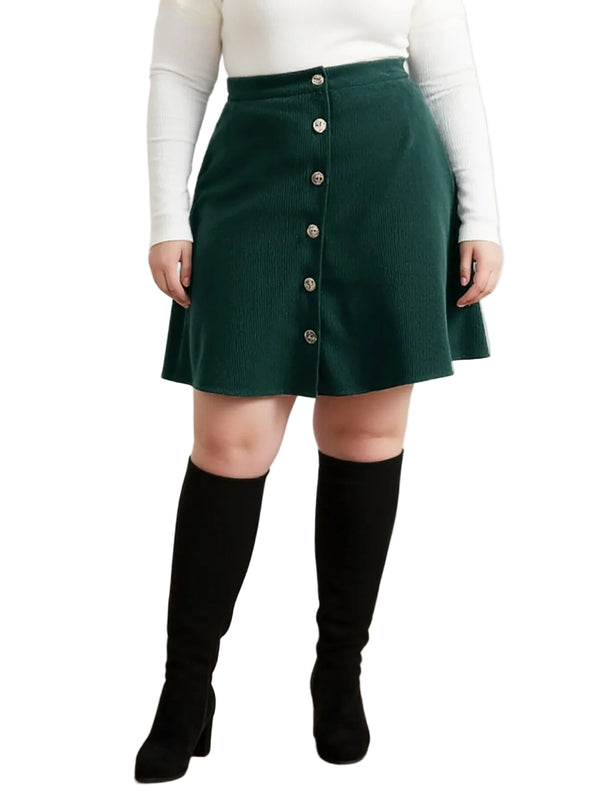
Vous n'avez pas besoin de six paires. Une excellente paire de poids moyen, à côtes moyennes, dans une couleur polyvalente, couvrira la majeure partie de l'automne si vous alternez les couches du dessus. Pour planifier une garde-robe coordonnée, il est utile de voir comment les cordons s'intègrent aux jupes et autres tissus d'automne dans la collection plus large de bas grande taille.
Pantalons en velours côtelé grande taille : Vos questions, nos réponses
Les pantalons en velours côtelé font-ils paraître plus grosse ?
Non – et cette prémisse mérite d'être remise en question. Ce qui affecte l'apparence des vêtements, c'est la coupe, la proportion et la longueur, et non la texture du tissu. Un pantalon bien ajusté, avec une taille et une coupe appropriées, a fière allure sur n'importe quel corps. Ce qui a vraiment l'air mauvais, c'est un pantalon trop serré au niveau des cuisses, trop court au niveau des jambes, ou trop bas au niveau de la taille – ce qui est vrai pour tous les tissus jamais fabriqués.
Quelle taille dois-je commander pour un pantalon en velours côtelé grande taille ?
Commandez en fonction de votre mesure la plus grande pertinente, généralement la hanche ou la cuisse, puis ajustez la taille si nécessaire. Vérifiez si les chiffres indiqués sont des mesures corporelles ou des mesures de vêtement à plat, car elles sont très différentes. En dessous de 2% d'élasthanne, envisagez de prendre une taille au-dessus ; avec 3–4%, votre taille habituelle est généralement la bonne. Vérifiez toujours la hauteur de taille avant indiquée plutôt que de vous fier aux mots « taille haute », que les marques définissent de manière incohérente.
Peut-on porter du velours côtelé par temps chaud ?
Oui, si vous choisissez le poids avec soin. Un velours côtelé fin d'environ 250 à 280 GSM est vraiment respirant et fonctionne de fin août à octobre, car le coton laisse mieux circuler l'air que la plupart des synthétiques. Gardez les velours côtelés larges, de plus de 400 GSM, pour les temps vraiment froids.
Comment éviter que le velours côtelé ne devienne brillant entre les cuisses ?
Choisissez une coupe large, droite ou tonneau pour que le tissu tombe loin de vos jambes, privilégiez le côtelé moyen, portez des shorts de cycliste lisses en dessous, alternez les paires et lavez à l'envers à froid. Lorsque la brillance apparaît, défroissez à la vapeur par l'envers et brossez le velours vers le haut. Une certaine usure est inévitable, mais ces étapes la ralentissent considérablement.
La version courte avant de faire vos achats
Optez pour un velours de largeur moyenne, sauf si vous avez une raison de ne pas le faire. Vérifiez la présence de 2 à 4 % d'élasthanne. Exigez un devant de 30 à 35 cm de hauteur avec une ceinture profilée et un élastique dans le dos. Choisissez une coupe ample au niveau des cuisses, et osez des couleurs comme l'olive, la rouille, le crème et l'ardoise, au lieu du marron. Si vous respectez ces critères, un bon pantalon en velours côtelé grande taille survivra entièrement aux cycles de la mode — chaud, confortable, et aussi bien adapté pour un lundi matin que pour un samedi soir.